The Complete Platform Guide
All In One Nonprofit is a complete platform of practical tools, courses, and free resources built specifically for 501(c)(3) nonprofits, the founders, executive directors, and volunteer boards who wear every hat and can't afford a different piece of software for every job.
Instead of one giant, complicated system, All In One Nonprofit is organized as focused apps grouped into areas that follow the real lifecycle of a nonprofit, from forming the organization, to governing it well, to running operations and staying compliant, to raising money and telling your story. Each tool does one job thoroughly and produces documents you can actually use: editable Word files, printable PDFs, checklists, and reports.
How it works
- Start with the assessment. Answer a few questions at allinonenonprofit.com/assessment and we will show you exactly which tools fit your organization right now, before you subscribe.
- One sign-in for everything. Signing in is passwordless: enter your email and we send a one-click sign-in link (signing in with Google also works). One sign-in recognizes you across every app and the main site.
- Built for organizations. Everyone who signs in with an email on your organization's domain joins your organization automatically; teammates on a personal email join with an invite code, so your board and staff share one profile.
- One subscription, everything included. A single All-Access Subscription unlocks every app and every AI automation. See pricing for the Founding Member rate.
- Your branding, automatically. Set up your letterhead, footer, and signature once and they flow onto the documents your tools generate.
- A signature library, not one signature. My Organization holds a list of signatures (for example the executive director and the board chair), each with a label, image, signer name, and title, and one marked as the Default. Every document window across the apps offers a Signature pull-down listing them, with the Default preselected, plus No signature. The chosen signer's name and title print under the image, so a letter the board chair signs reads as the chair's letter.
Getting Started
You can be up and running in a few minutes. Here's the recommended order.
Want to look around first? Every app has an interactive demo mode, just add ?demo=1 to any app's web address (for example donors.allinonenonprofit.com/?demo=1), or browse them all from the demo page, to explore the full app loaded with sample data, no sign-in or purchase required. In demo mode the AI automations show a realistic sample of what they produce (instead of an error), so you can see each tool's output before you subscribe, and to keep the preview a preview, all exports (download, copy, and print) are turned off and replaced with a friendly Subscribe prompt.
- Sign in. Go to the member portal at app.allinonenonprofit.com (or click Sign in on any app), enter your email, and we send you a one-click sign-in link (you can also use Google). The portal lists all your apps in one place, the app launch grid sits right at the top with clear, readable text, and cards below it cover the Workflow Assessment, notifications, onboarding, and support, and you'll be recognized everywhere, open another app and it just knows you.
- Set up your organization & document branding. In a tool's Settings (or organization profile), add your organization name, address, and EIN, upload your letterhead, fill in your footer details, and add your signature. These appear automatically on the documents you generate. (See Site-Wide Features.)
- Invite your team. Use the "My Organization" page to create your organization so your board and staff share one profile. Anyone who signs in with an email on your organization's domain joins automatically; people using a personal address join with the invite code or email invitation you send.
- Pick your starting point. Choose the apps that match where your organization is right now, just forming, tightening governance, running operations, or fundraising. The five lifecycle areas below follow that order, and your All-Access Subscription includes all of them.
- Generate, customize, export. Most tools follow the same rhythm: answer a few questions, generate a draft, tweak it, and export to Word or PDF, already on your letterhead.
Start with your role
The apps do the work; each role has a short first-week track that tells you what to open and in what order. Pick your seat, each link opens the matching track in the Platform Workflows.
Automate Your Workflow!
Over 200 AI automations across the platform draft your letters, plans, minutes, and reports from the information you already entered. You review and edit everything before it is used.
Tools with AI automations
- AI Workflow Automation, 75 ready-to-run templates drafted by AI from your answers, plus your own uploaded custom templates, a plain-language "What do you need?" search, and freeform AI drafting when no template fits, with an approval outbox, follow-up reminders, and email built in. Open the app →
- Donor Management (21): thank-you letters, year-end giving statements, lapsed-donor win-backs, cultivation briefs, and a weekly who-to-call digest. AI guide →
- Technology & Digital Services (17): a full annual technology plan, website audit action plans, tech budgets, policy packs, website copy, and quick wins for your stage. AI guide →
- Board Management (19): meeting minutes and agendas, the board packet and annual budget compilers, a spending policy drafter with invoice approval log, succession plans, and a governance calendar. AI guide →
- Committees (22): charters and gap reviews, financial oversight reports, budget requests, editor publication reports, the internal financial review, subcommittee charters, agendas, minutes, and annual work plans. AI guide →
- Membership (12): renewal reminders and bulk renewal sends, new-member welcomes, dues receipts, lapsed-member win-backs and campaign plans, a directory compiler, and an annual membership report. AI guide →
- Volunteer Management (9): a full volunteer handbook, recruitment and onboarding plans, recognition notes from real logged hours, and shift appeals. AI guide →
- Fundraising & Development (9): annual development plans, campaign plans, gift range charts, readiness assessments, and fundraising calendars. AI guide →
- Marketing (8): campaign kits, press releases, newsletters, email sequences, and social post packs. AI guide →
- Risk Management & Insurance Audit (9): a full risk management plan compiler, a risk register, coverage gap analysis, crisis plans, broker briefs, and event and vendor reviews. AI guide →
- Grant Management (7): a full proposal compiler, letters of inquiry, funder-fit briefs, logic models, budget narratives, and grant reports. AI guide →
- Compliance Tracker (7): an annual compliance plan from your live filing data, board reports, gap assessments, and resolutions. AI guide →
- Impact & Outcomes (7): impact narratives, funder reports, theory-of-change builders, indicator recommendations, and surveys. AI guide →
- Operations Audit (7): improvement plans from your audit scores, board summaries, internal-controls checkups, and SOPs. AI guide →
- HR Management (7): offer letters, job descriptions, interview kits, performance improvement plans, and conversation prep. AI guide →
- Board Handbook (7): handbook gap reviews, plain-English bylaws summaries, chair welcome letters, and orientation plans. AI guide →
- Executive Director (7): board reports, annual goals from your strategy, a self-evaluation narrative, conversation talking points, a 90-day plan, an ED job description, and a new-ED welcome. AI guide →
- Board Officers (7): officer welcome letters, tailored role descriptions, onboarding plans, succession briefs, transition memos, outgoing-officer thank-yous, and new-officers announcements. AI guide →
- Annual Report (6): your ED letter, program narratives, at-a-glance highlights, and a full report compiler. AI guide →
- Scholarship Management (6): a full program plan, eligibility and criteria builder, donor updates, and award, decline, and announcement drafts. AI guide →
- Document Retention & Security (5): an AI Acceptable Use Policy, a Third-Party & AI Vendor Vetting Policy, a Social Media Policy, a BYOD & Remote-Work Device Policy, and a Policy Binder Compiler. AI guide →
Every automation lets you copy, download as Word or text, print, email, or queue the result for approval. See pricing for which plan each belongs to.
Predictions
Ten apps now include a Predictions page that reads the data already in your app and flags what is likely to need attention next, so you can act before a problem lands instead of after.
Every prediction is transparent and built from your own data. There is no black-box machine learning: each score shows the factors behind it (for example, time since last gift, missed deadlines, or declining scores), so you can see exactly why something was flagged and decide what to do. Predictions are guidance, not guarantees, and they are free for everyone. Each Predictions page also offers one AI brief button that writes a short plain-language summary of what the numbers mean and where to focus; that brief is one of the AI automations included in your subscription.
Apps with Predictions, and what each one predicts
- Donor Management: donor lapse-risk plus giving-capacity and who is ready to be asked to upgrade. Open the app →
- Membership: member renewal-risk plus a dues forecast. Open the app →
- Grant Management: a grants pipeline forecast, a funder-fit indicator, and deadline risk. Open the app →
- Fundraising & Development: a grants pipeline forecast and deadline risk. Open the app →
- Compliance Tracker: deadline-miss risk for your filings. Open the app →
- Volunteer Management: volunteer attrition and disengagement risk. Open the app →
- Impact & Outcomes: outcome trajectory, whether you are on pace or behind a target. Open the app →
- Board Management: attendance risk plus a term-cliff view of which seats are coming up for renewal. Open the app →
- Operations Audit: capacity risk by audit area, surfacing low or declining scores. Open the app →
- Scholarship Management: rubric-based applicant ranking and a shortlist. This is a decision aid for a human committee, objective and nondiscriminatory; it never makes an automated award. Open the app →
Workflow Assessment
A guided review of how your organization actually operates: 123 questions across 15 operational areas that turn your answers into a prioritized action checklist, with a deep link into the exact screen that fixes each gap.
How it works
- 123 questions across 15 operational areas: board governance, fundraising, grants, volunteers, membership, financial management, compliance, HR, programs, marketing, events, records, risk, technology, and leadership.
- Scoped to your stage: you pick your organization's life-cycle stage (Just starting, Newly formed, or Established) and the question set fits it; earlier stages get shorter sets. Your organization name and EIN pre-fill from your Organization Profile.
- One shared living document: any signed-in team member can contribute, everyone works on the same assessment, and every answer saves automatically. For each question you record your current practice (three levels, or Not applicable), rate its impact from 1 to 5, and add an optional note.
- Scoring that prioritizes: the gap between your current practice and the goal is multiplied by the impact you assigned, so the significant gaps rise to the top.
The action checklist
- Significant gaps become a prioritized action checklist grouped by domain. Every item shows your current state, the goal, and step-by-step how-to-fix guidance, and every one of the 123 questions carries a deep link into the exact screen of the right app, so fixing a gap starts one click away.
- Checking an item off is task tracking only. A hint under a checked item invites you to update the underlying answer; updating the answer is what actually removes the gap and recomputes the checklist instantly. A Review or edit your answers button reopens the question flow at any time.
- Re-assess archives your current pass as a snapshot (so you can see progress over time) and starts a fresh pass, keeping your stage.
The portal card keeps you oriented: before you start, it explains that the assessment will analyze your workflows and show how to improve them with AI automations across the platform; in progress, it shows how many of the questions you have answered; and once complete, it shows how many priority gaps the assessment identified from your answers, then how many of those gaps you have addressed.
⛪ Using the Platform as a Church or Faith-Based Organization
The platform understands that a church is not a standard nonprofit: it files no annual return, its minister is paid under different tax rules than any other employee, and its giving arrives in numbered envelopes on Sunday morning. Set your organization type once and every app adjusts. Here is the whole journey, from "are we a church?" through weekly operations.
Step 1: Confirm you are a church in the IRS sense
This answer changes everything downstream, so settle it first. A church is automatically tax-exempt, files no Form 990, and cannot use Form 1023-EZ. A religious organization that is not a church must apply for recognition and file the 990 series every year. The IRS weighs fourteen characteristics and no single factor decides it, so use the guided 14-factor church check: it walks each characteristic, records your answers, and produces a written rationale your board can keep. It is linked from the Formation Assistant, the Form 1023 tool, and the Compliance Tracker, and takes about ten minutes.
Step 2: Formation and the 1023 decision
Form the corporation like any nonprofit with the Nonprofit Formation Assistant; it routes churches to 509(a)(1) public-charity status by activity, with no public support test, and to Schedule A. The Form 1023 tool knows churches cannot file the streamlined 1023-EZ and says plainly that a church is automatically exempt and may choose not to apply at all; many still file the full 1023 voluntarily so donors and grantmakers can see a determination letter.
Step 3: Compliance without the 990
Tell the Compliance Tracker you are a church and it removes the entire 990 series, with a notice explaining the exemption (IRC 6033(a)(3)(A)(i)) and why the three-year auto-revocation rule does not reach you. It keeps in front of you what a church still owes: payroll filings if you have employees, Form 990-T if unrelated business income reaches $1,000, state corporate and charitable registrations, and one deadline unique to churches, the annual housing allowance designation, described next. Its setup wizard gives a church the true reason it asks for revenue (state audit thresholds and registration tiers, not a Form 990 version), and its Course Modules carry a church notice naming which lessons do not apply.
Step 4: Pay your minister correctly
The Employment & HR app gains a Clergy Compensation section for churches. Ministers are dual-status: no FICA on ministerial wages (the minister pays SECA instead unless a timely Form 4361 exemption applies), income tax withholding only if elected, and a housing allowance that is excluded for income tax but stays in the SECA base. The section runs the least-of-three housing worksheet (designated amount, actual costs, fair rental value), stores the designation record with a hard block on retroactive dates, tracks the minister flags and the unforgiving Form 4361 deadline, and walks the W-2 boxes that differ for a minister. Churches also owe no FUTA on any employee, and the payroll checklist and compensation calculator both say so. Every clergy screen carries the same line: this tool structures, calculates, and documents; your CPA or tax counsel confirms the numbers.
Step 5: The annual housing allowance resolution, the loop no church software runs
The housing allowance must be designated in advance, by official board action, before the payments it covers (Treasury Regulation 1.107-1(b)), and it cannot be backdated. Churches miss this constantly, and every missed month costs the pastor the exclusion. Here the three apps close the loop: the Compliance Tracker fires the annual deadline before January 1, the HR worksheet produces the figure, and the Board Management Resolutions page shows churches a band that prefills the formal designation resolution and routes it to the board for e-signature, with the adopted, signed copy auto-filed in your Document Library. Put it on the November agenda every year.
Step 6: Sunday giving, envelopes, and the counting team
Donor Management handles congregational giving the way your counting team actually works. Assign each giving household an offering envelope number on its record (with a duplicate check so two households never share a number), then on Monday open Gifts → Offering count and batch-enter the plate: envelope number and amount per row, a check number if it was a check, the giver’s name resolving beside each row as you type, and blank-envelope rows recorded as loose offerings. Every line becomes a normal gift, so year-end giving statements (with the quid pro quo wording the IRS expects), thank-yous, funds, and the accounting export with restriction classes all work unchanged. Restricted funds like a building or missions fund are just designations on the gift. Recurring commitments display as tithes, and online giving through your own Stripe account feeds the same records automatically. One safeguard runs at the point of entry: a gift whose designation points at a person rather than the ministry (a love offering, a wedding or funeral fee) triggers a caution that it is taxable compensation to that person and belongs in payroll, not on a giving statement.
Step 7: Your own words, everywhere
With the church organization type set, the platform speaks your language across every app: donation becomes offering, donor becomes giver, board becomes council, program becomes ministry, a recurring gift becomes a tithe. Because traditions differ, governance titles are yours to set: use the per-term overrides on My Organization to display elder, deacon, vestry, session, or trustee wherever the platform says council. Only the words on screen change; your stored records, exports, and formal documents keep standard names, so a resolution still says what your bylaws say.
What this platform deliberately is not
This is your church’s back office: governance, compliance, people, money, and communication. It is not worship software, so service planning, attendance and child check-in, and scheduling volunteers by service remain the territory of dedicated church management tools, and it does not prepare denominational reports. Everything tax-related here is educational: structure, calculate, document, then have your CPA or tax counsel confirm.
Formation Apps
Everything you need to legally form a 501(c)(3) and set it up right, from incorporating with your state to drafting the documents the IRS expects.
Nonprofit Formation
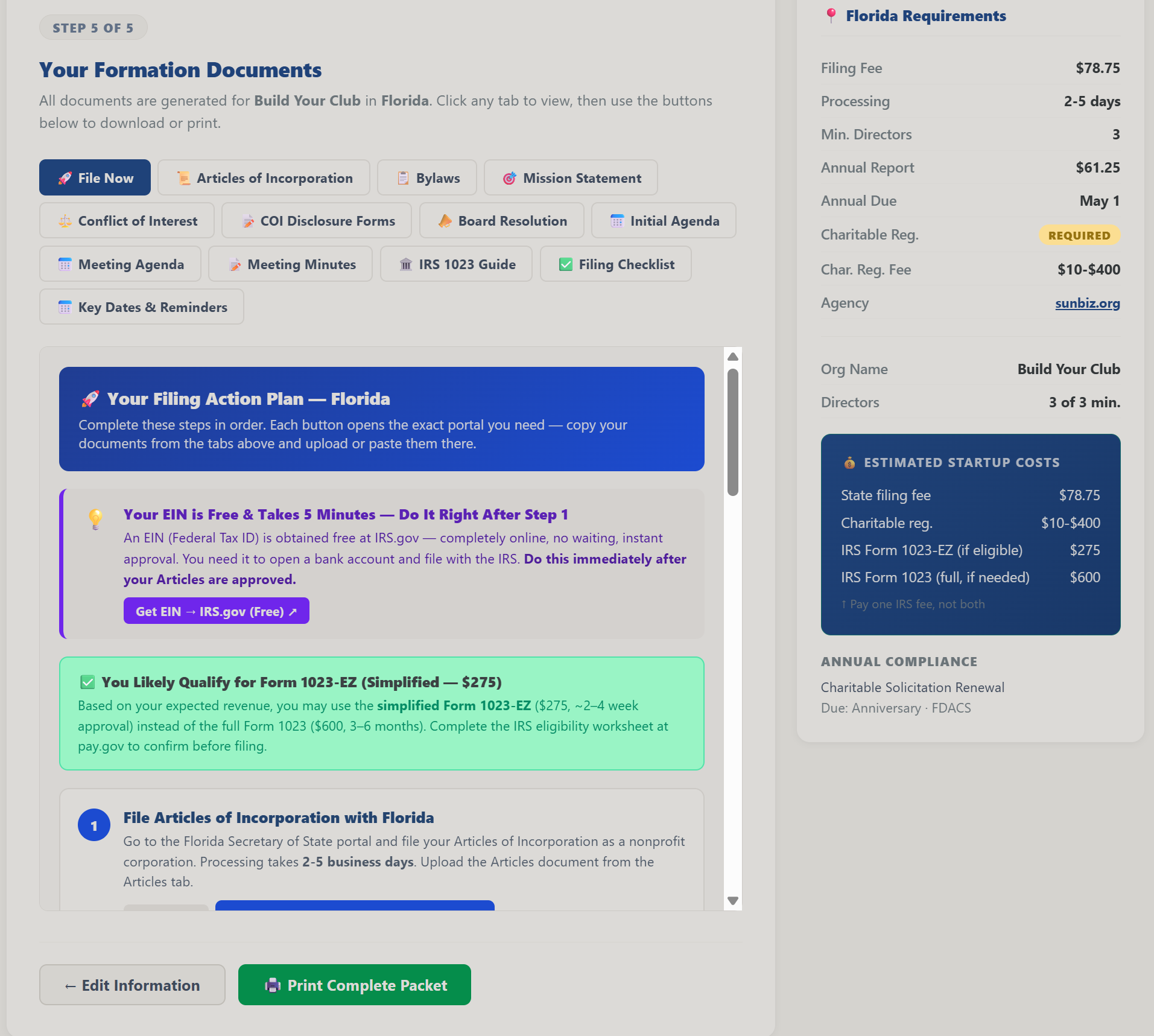
End-to-end help to legally form a 501(c)(3) in any of the 50 states, from incorporating with the state to drafting the documents the IRS expects.
Key features
- State-specific guidance for all 50 states, the steps, agencies, and requirements that actually apply to you.
- Articles of Incorporation generator that includes the IRS-required purpose and dissolution language.
- Bylaws generator reflecting your state's nonprofit act.
- Form 1023 preparation: narratives, schedules, and attachment guidance (continue in the IRS Forms Assistant).
- First board meeting kit: agenda, minutes template, and founding resolutions.
- Choose the right 501(c)(3) status: guidance on public charity vs. private foundation and the 509(a)(1), 509(a)(2), and 509(a)(3) classifications, including operating vs. non-operating private foundations.
- Be your own registered agent, or use a service: a plain-language comparison that leads with the privacy of keeping your home address off the public record.
- Built-in glossary of formation terms (501(c)(3), registered agent, dissolution clause, and more) in plain language.
- Your progress is saved automatically, and documents export to editable Word.
How to use it
- Select your state and answer a short set of questions about your organization.
- Work through the roadmap, running each generator (Articles, Bylaws, first-meeting kit) as you reach it.
- Review and edit the generated text, then export to Word to finalize and file.
For a step-by-step first session, see the Nonprofit Formation guide.
Open the Nonprofit Formation →IRS Forms Assistant
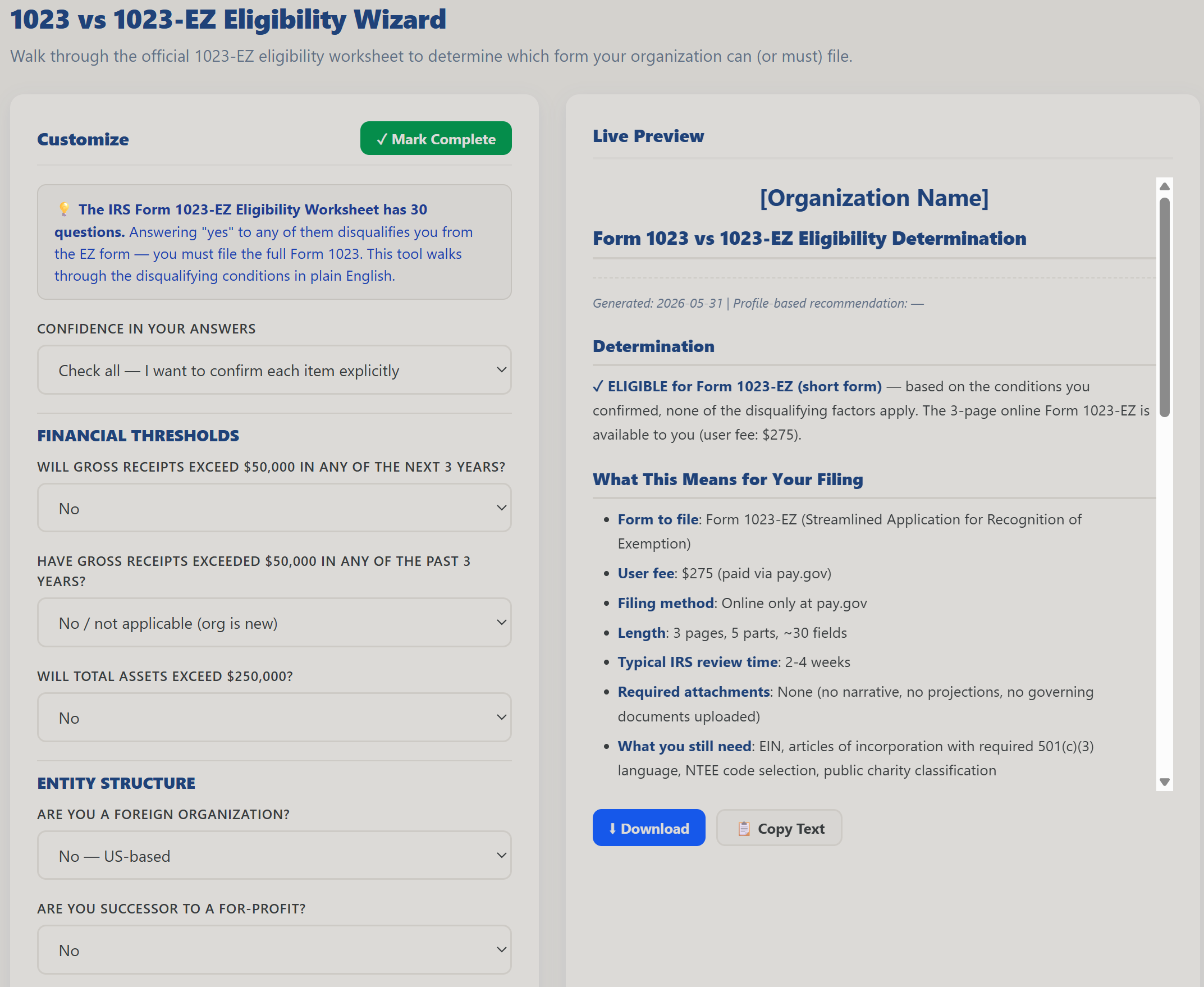
One tool for the three IRS filings a nonprofit runs into most: the Form 1023 application for 501(c)(3) tax-exempt status, the Form 1024 application for other exempt organization types, and the annual Form 990 return once you're up and running. It replaces what used to be three separate apps.
Key features
- Form 1023 application: a 1023-EZ eligibility wizard, seven guided generators, a narrative builder with an AI drafter for the Part IV Narrative Description of Activities, and a public support test calculator.
- Form 1024 application for organizations that are not 501(c)(3) charities: type-aware guided parts for 501(c)(4), (5), (6), and (7) organizations, Form 1024-A and Form 8976 awareness for social welfare groups, and an activities narrative drafter.
- Form 990 annual return: a version selector (990-N, 990-EZ, or the full 990), a document checklist, a Program Service Accomplishments tool for Part III with an AI drafter, and a Public Support Test calculator covering both the one-third test (Schedule A Part II) and the 509(a)(2) test (Part III).
- Glossary of IRS terms across all three filings (public charity vs. private foundation, 509(a)(1)/(a)(2), public support test, UBIT, and more).
- Cross-links to the Nonprofit Formation app, document branding, and Word export of everything.
How to use it
- Pick the filing you need: Form 1023, Form 1024, or Form 990.
- Work through that filing's guided parts, using the narrative or program-accomplishments drafter for the written sections.
- Export to Word, review against the live IRS form, and file (or hand a clean package to your filer).
Keeping your public charity status
Most 501(c)(3) organizations are public charities, and that status is worth protecting. Public charities offer donors higher deduction limits, pay no tax on investment income, and face no mandatory annual distribution. Private foundations get none of that and carry stricter self-dealing rules on top.
The status is not permanent. The IRS measures it with a public support test over a rolling five year window, and an organization that falls below the line long enough is reclassified as a private foundation. The sector calls this "tipping," and the usual cause is not misconduct. It is one unusually large gift that quietly changes the math, because any single donor only counts toward public support up to 2 percent of total support. The rest of that gift still helps the organization; it just does not help this ratio.
Two details that keep people calm when they first meet this:
- Falling below the line for a single year is a warning, not a reclassification. Status is lost after failing two consecutive years.
- An organization in its first five tax years is treated as publicly supported without the computation at all.
Where to work it out: the Form 990 tool includes a Public Support Test calculator covering both Schedule A Part II and Part III. Board Management has a full lesson on the arithmetic and the warning signs.
A note on advice: public support calculations carry exceptions that depend on your facts, including unusual grants and which of your funders are governmental units or other public charities. Use the calculator to understand your position, and work with a nonprofit CPA or tax attorney on your filing.
For a step-by-step first session, see the IRS Forms Assistant guide.
Open the IRS Forms Assistant →Board Handbook
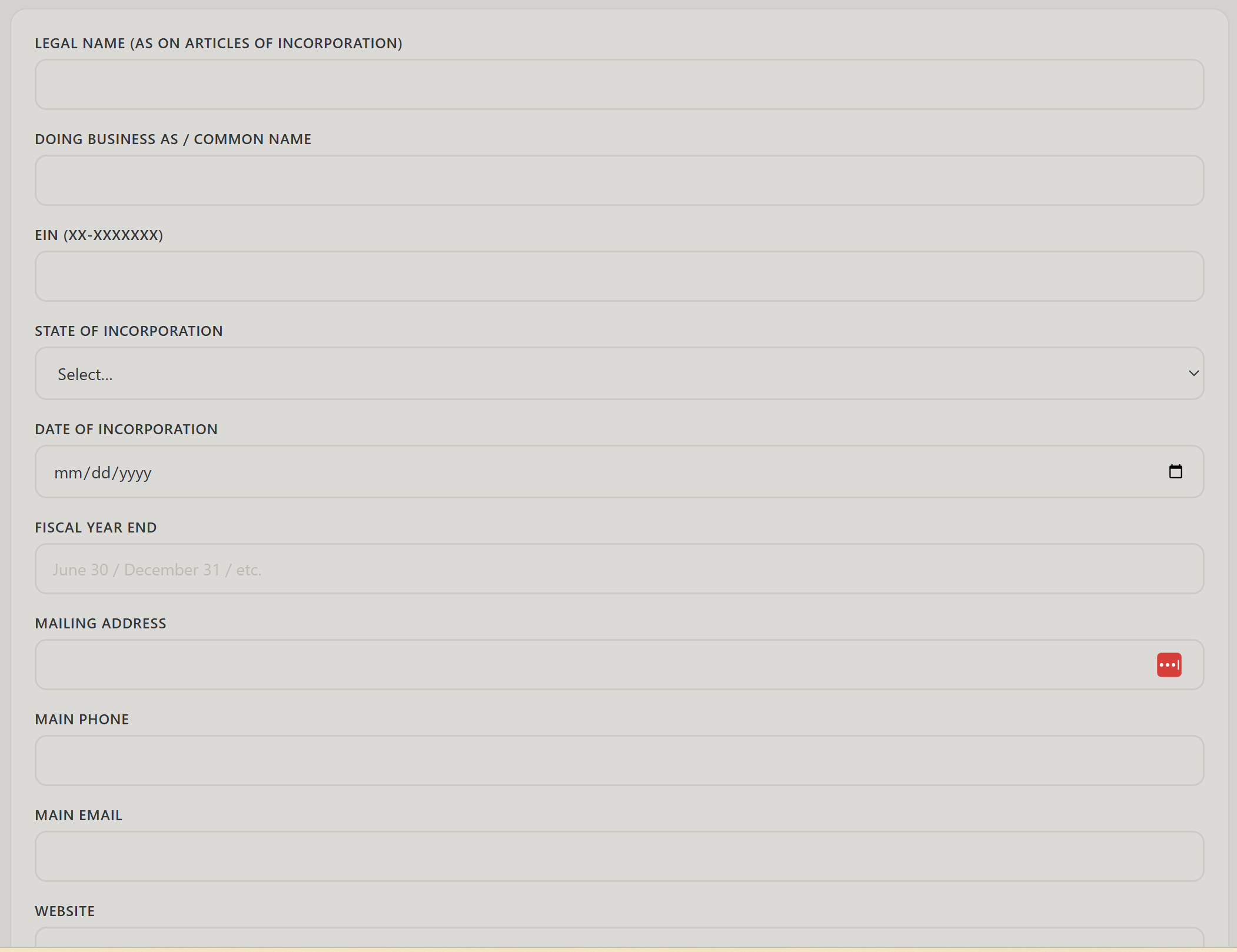
Generates a complete, professional board handbook across the eight essential sections every board should have, the document you hand every new director on day one.
Key features
- Eight complete sections: organization overview, roles & responsibilities, policies, meeting practices, and more.
- Fill in your org name, mission, and board details once and they flow throughout.
- Customize any section; your edits persist between visits.
- Word export of the full handbook, on your letterhead if you've set up document branding.
- Send for signature: send the handbook acknowledgment (or any generated document) to your directors for electronic signature, prefilled from your board roster, using the platform's e-signature system; signed copies file automatically into your Document Library.
How to use it
- Enter your organization basics.
- Generate all eight sections, then customize the language to fit your board.
- Export to Word and distribute to your directors.
For a step-by-step first session, see the Board Handbook guide.
Open the Board Handbook →AI Workflow Automation
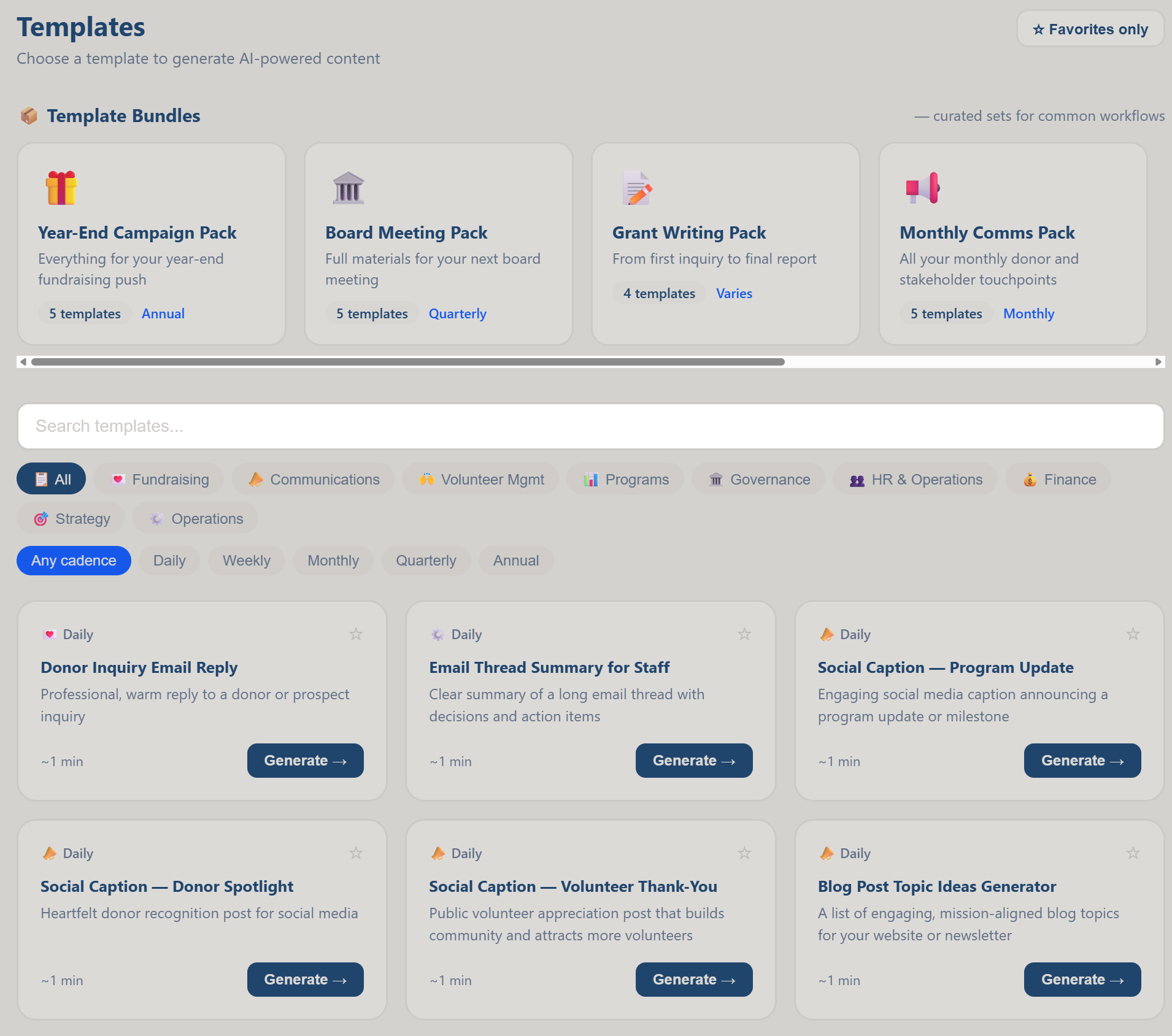
A template-driven content generator for nonprofit communications, 75 ready-to-use templates that turn the writing you dread (thank-yous, appeals, board updates, social posts, press releases) into a few clicks.
Key features
- 75 templates organized by cadence (Daily, Weekly, Monthly, Quarterly, Annual) and department (fundraising, communications, operations, governance, and more).
- "What do you need?" search on the dashboard: type what you're trying to create in plain language and jump straight to the best-matching templates, or click Draft it with AI instead and the AI writes the document freeform when no template fits.
- Upload your own templates: turn any letter or document your organization writes repeatedly into a private, reusable custom template. The AI detects the fill-in fields for you, and your custom templates show up in the library and every search.
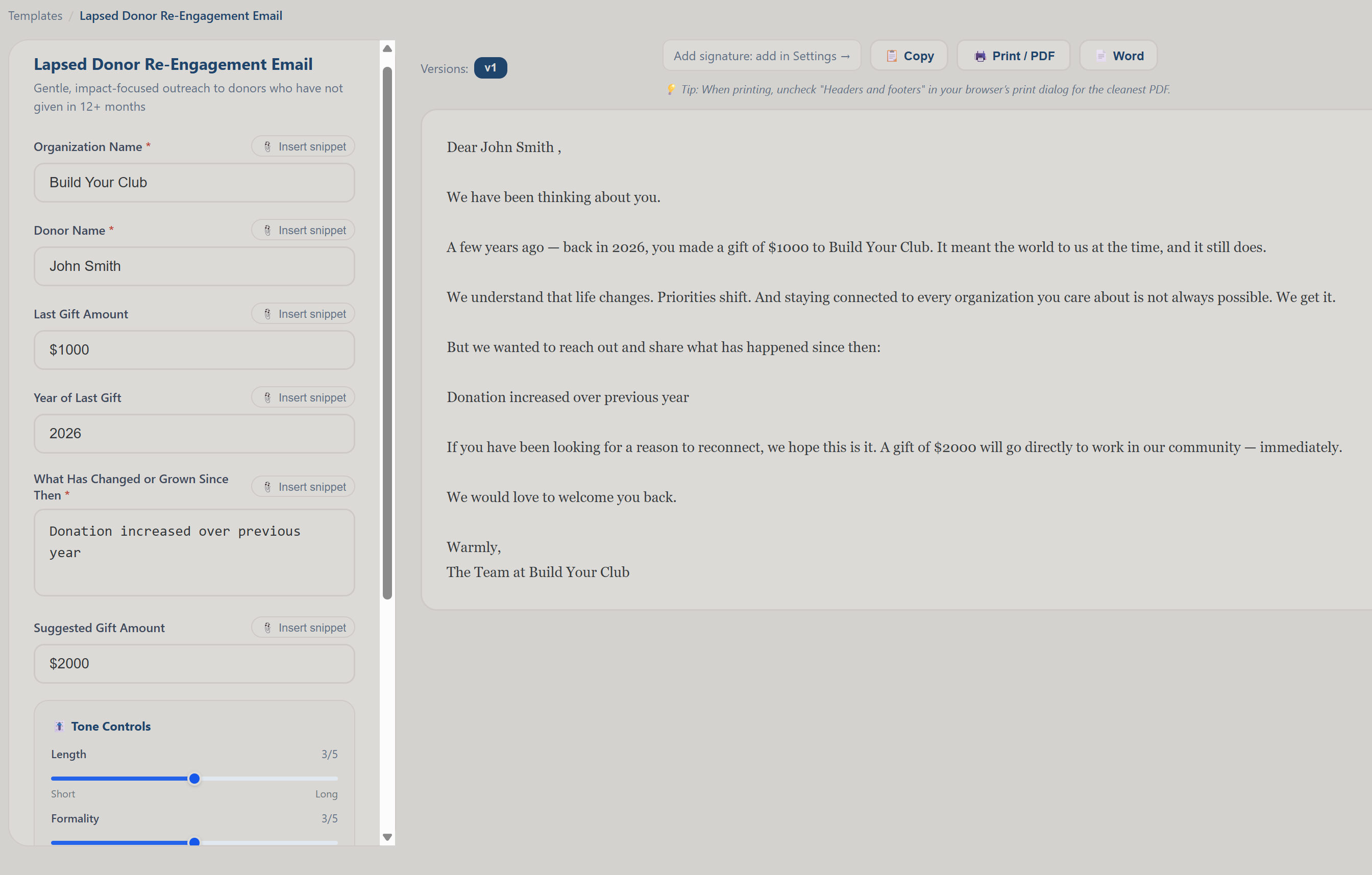
- Tone controls (length, formality, urgency, simplicity, voice) to match each piece to its audience.
- Versions, drafts, and reusable snippets so you can iterate and reuse your best language.
- Document branding built in: each template knows what it is, letters and emails get your signature, documents get your letterhead and footer, and quick social/digital content gets none. You can toggle any of it per export.
- Export to Word, Print/PDF, or copy to clipboard; team view and a content analytics snapshot included.
How to use it
- Browse or search the template library and pick what you need.
- Fill in a few fields, adjust the tone sliders, and generate.
- Refine, then export to Word or print to PDF, already on your letterhead.
For a step-by-step first session, see the AI Workflow Automation guide.
Open AI Workflow Automation →Volunteer Management
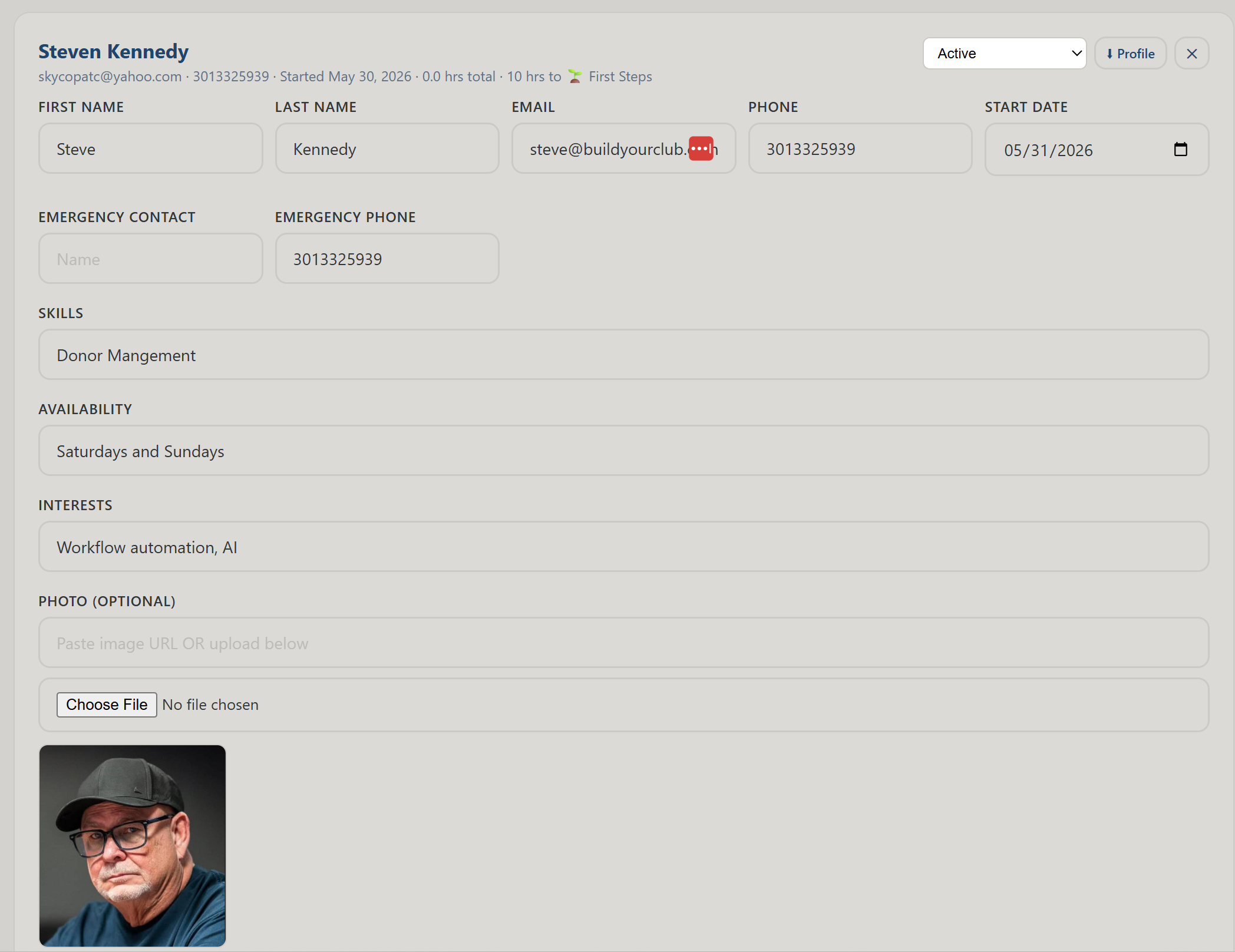
Track your volunteers, shifts, and hours, plus background checks, risk indicators, and recognition, in one lightweight place built for organizations that run on volunteer power.
Key features
- Volunteer records: name, contact, role, and status in one list.
- Shift scheduling and hour logging, with running totals.
- Background-check workflow to track each volunteer's status.
- Risk indicators surfaced on a dashboard.
- Recognition tools (spotlights, milestones) and roster export.
- Predictions (free): volunteer attrition and disengagement risk. See Predictions.
- Install it on your phone: works offline once installed, with optional push notifications for open shifts and volunteers due for recognition.
How to use it
- Add your volunteers and their roles.
- Schedule shifts and log hours as they're completed.
- Track background checks and use the dashboard to spot gaps; export your roster when you need it.
For a step-by-step first session, see the Volunteer Management guide.
Open Volunteer Management →Governance Apps
Help your board actually function: board management, committee structures, risk and insurance, name changes, impact measurement, and membership management.
Board Management
A complete board operations app: a structured course on how a nonprofit board actually works, plus the living tools to run one, a board of directors roster, an officers directory, a succession page, and AI automations that draft your minutes, agendas, and board packets.
Key features
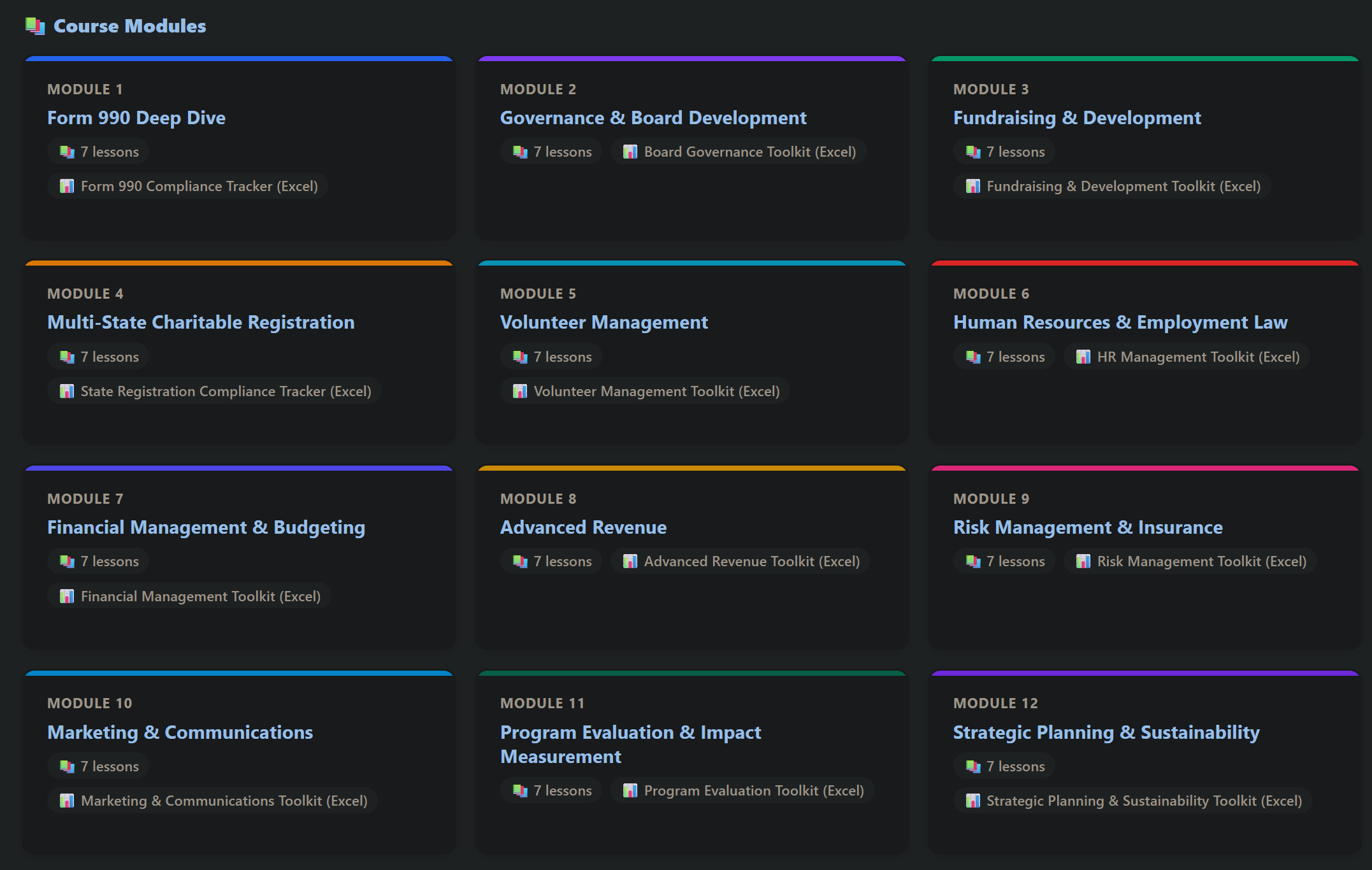
- Board Management course: self-paced lessons on the board's legal duties (care, loyalty, obedience), recruiting and onboarding directors, and running effective meetings, agendas, quorum, voting, and minutes, with notes, a resource library, and progress you can mark complete.
- Board of Directors roster: track every director's role, term, and contact details in one place.
- Officers directory and a succession page to record your leadership slate and plan transitions.
- Live in-meeting Motion Tracker: on a meeting record, open a motion (with who made and seconded it and the pass threshold), then capture each member's vote (For, Against, Abstain, or Recuse). A live tally, a quorum check, and a pass or fail result update as you record votes, and the full motion record is written into that meeting's minutes (and carried into the AI-drafted minutes).
- Board Resolution sign-off workflow: compose a resolution (number, date, title, and text) and route it to each director for electronic sign-off. Each signer gets a private link, and you see per-signer status (signed or pending) with the signed name, date and time, IP address, and signature type. A completion report gives you the full audit trail, and the adopted resolution files itself into your Document Library.
- ⛪ Churches, the annual housing allowance resolution: when your organization type is Church or faith based, the Resolutions page adds a band that prefills the minister’s Section 107 housing allowance designation resolution with the proper advance-designation language (it must be adopted before the payments it covers and can never be backdated, per Treasury Regulation 1.107-1(b)). Confirm the figure in the HR app’s Clergy Compensation worksheet, replace the brackets, and send it for sign-off; the Compliance Tracker carries the annual before-January-1 deadline. See Using the Platform as a Church.
- ED Evaluation (the board's annual review of the executive director): a chair-led, 7-step process (governance calendar, goals, board input, the ED's self-evaluation, an executive session, compensation with comparability data, and minutes) with an autosaving worksheet, a Build evaluation record document, and an AI-drafted evaluation summary. A "Board input and year-round notes" card lets the chair gather notes from any board member all year, by paste or by uploading a Word, PDF, or text file; then Compile notes into the worksheet (AI) synthesizes the themes without naming who said what and drops them into the worksheet for you to review before anything is saved. It links both ways with the Executive Director app's self-evaluation.
- Continuity Plan (key-person loss): the board records, ahead of time, who holds every account and login, key and vehicle, one-person relationship, and recurring duty, with a backup for each and where the credential lives (never the password itself). People come from the board roster, officers, HR directory, and My Organization positions. A first-30-days worksheet plus a Draft the 30-day plan (AI) button turns it into a day-one, first-week, first-month plan; build the whole plan as a Word document on letterhead or save it to the Document Library; the next review date lands on the Organization Calendar and the Dashboard shows the plan's status.
- Founding Board: First 90 Days checklist: a saved, interactive start-here guide for a brand-new board standing up governance from zero (seat your directors, elect officers, adopt bylaws and policies, collect conflict-of-interest disclosures, hold the first meeting, form committees, and set the governance calendar), with each step linking to the tool that does it.
- 19 AI automations: meeting minutes and agendas, board-packet and annual-budget compilers, a spending-policy drafter with an invoice approval log, succession plans, and a governance calendar.
- Board reports cite your real impact: the board-packet and board-report compilers now weave in your real measured program impact (cost per outcome and results) from the Impact & Outcomes app when you have captured it, so board reports cite real numbers instead of placeholders.
- Settings and document branding so everything you export carries your letterhead and footer.
- Predictions (free): attendance risk plus a term-cliff view of which seats are coming up for renewal. See Predictions.
How to use it
- Work through the course lessons, or jump to the topic you need.
- Build your board of directors roster and officers directory, and plan ahead on the succession page.
- Open AI Automations to draft minutes, an agenda, or a board packet, then export them on your letterhead.
For a step-by-step first session, see the Board Management guide.
Open Board Management →Committees
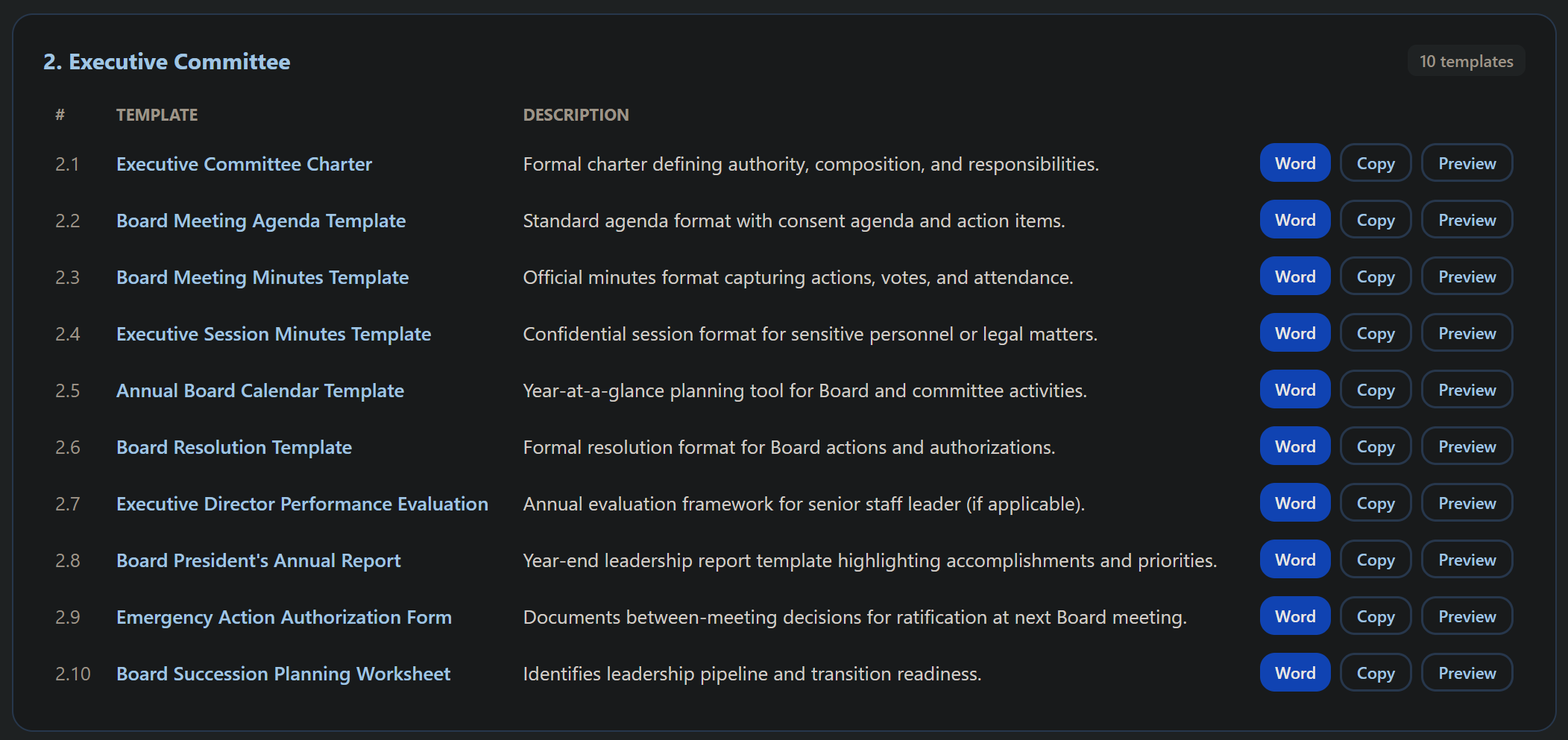
Set up and run board committees the right way, with charters, rosters, and a searchable library of 126 ready-to-use templates that you can customize and export to Word.
Key features
- 126 templates across every common committee: charters, agendas, work plans, and reports.
- Smart search: the Templates Directory understands plain-language requests (synonyms and related words) and shows a ranked Top Matches panel, so you find the right template fast.
- Build Handbook: pick exactly which standing and ad hoc committees to include, then Preview the assembled committee handbook in a new tab before exporting to Word, Print/PDF, Copy, HTML, or Text.
- Generate, preview, copy, or export to Word, on your letterhead if you've set up document branding.
- Committee setup and rosters tied to your team's organization profile.
- Audit committee charters: an enriched Finance & Audit charter and a separate standalone Audit Committee charter (auditor RFP and rotation, independence, executive sessions, management-letter follow-up, and the federal Single Audit) for orgs that keep audit independent of finance.
- Send a charter for board adoption: any committee not yet marked adopted has a Send for board adoption button that wraps its charter in formal resolution language and routes it to the board members you pick for e-signature. A status line tracks signatures ("Adoption pending: X of Y board signatures in"), and when the last director signs, the committee's Adopted flag and date flip automatically and the signed resolution PDF files itself into your Document Library; a manual Adopted checkbox remains for boards that vote in meetings.
- Committee chair Getting Started checklist: an interactive 12-step checklist at the top of the sidebar walks a new committee chair from board adoption to a reporting rhythm, with progress saved as you go.
- Committee Reports (member input to board report): the chair opens an input request with a prompt and due date, every committee member is emailed and notified in their member portal, and members submit updates from the portal. One click on Compile report (AI) synthesizes all the input into a single board-ready report (Purpose, Highlights, Work completed, In progress, Issues, Decisions requested, Next period) that you can email and save to the Document Library from the draft window.
- Members & Recruitment: a recruitment pipeline (stages Identified, Invited, Joined, Renewed, Rotated off, and Declined) with skills and term-end dates, a 90-day term-renewal banner, and per-person AI letters (invite, welcome, and thank-you).
- Exceptional-service nominations with a recognition log: AI drafts a formal nomination letter to the board chair grounded only in the reasons you give, and every nomination lands in a recognition log where each entry carries a resolution status (Pending, Awarded, Denied, or Withdrawn) with the decision date.
How to use it
- Choose a committee and the template you need.
- Generate it, customize the language, and preview.
- Export to Word or copy it into your minutes or packet.
For a step-by-step first session, see the Committees guide.
Open Committees →Risk Management & Insurance Audit
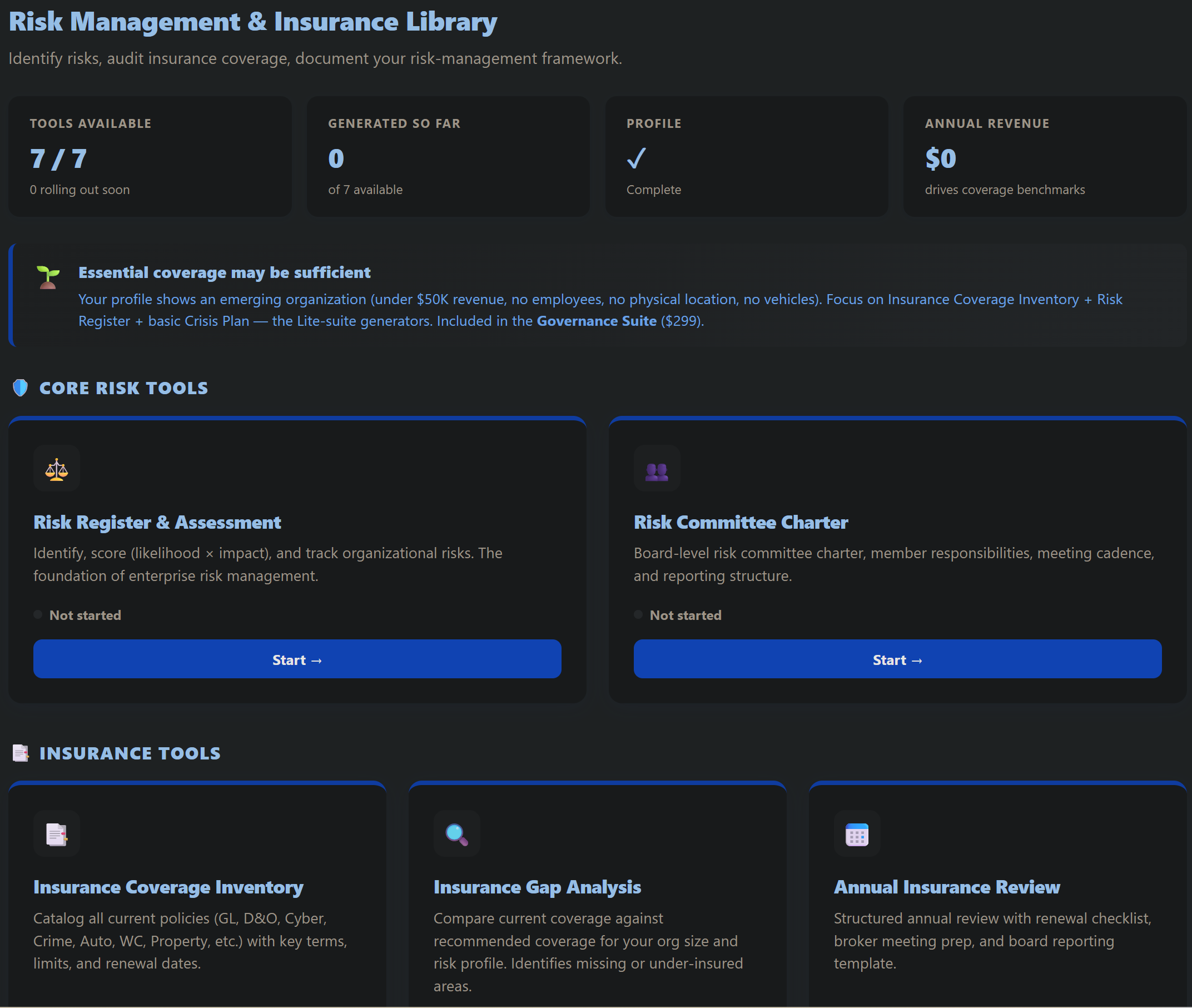
Identify the risks a nonprofit faces, document how you'll mitigate them, and figure out the insurance coverage you actually need, in plain language.
Key features
- Risk assessment across operations, finances, people, and events.
- Insurance guidance: what general liability, directors & officers (D&O), and other coverage do and whether you need them.
- Mitigation tracking so each risk has an owner and a plan.
- Single Organization Risk Score: a Risk Score page rolls your risks into one 0 to 100 index with a plain-language band (Low, Moderate, High, or Severe) and names the top drivers. You rate each risk by likelihood and impact (1 to 5) and check the ones you have mitigated; it comes seeded with seven standard categories (Financial, Operational, Governance and compliance, Reputational, Cybersecurity and data, People and HR, and Strategic). It is a self-assessed management index, not an actuarial or insurance-adequacy score. The score feeds the Organization Health Copilot as a Risk signal and flows into the organization-data AI assistant. See Site-Wide Features.
- Insurance Coverage Inventory: the coverage preview now collapses by header (General Liability, Directors and Officers, and so on), with Expand all and Collapse all so a long list stays scannable.
- Glossary of insurance and risk terms in plain language.
How to use it
- Work through the assessment to surface your key risks.
- Review the recommended coverage and note what you carry.
- Record your mitigation steps and revisit them annually.
For a step-by-step first session, see the Risk Management & Insurance Audit guide.
Open Risk Management & Insurance Audit →Name Change
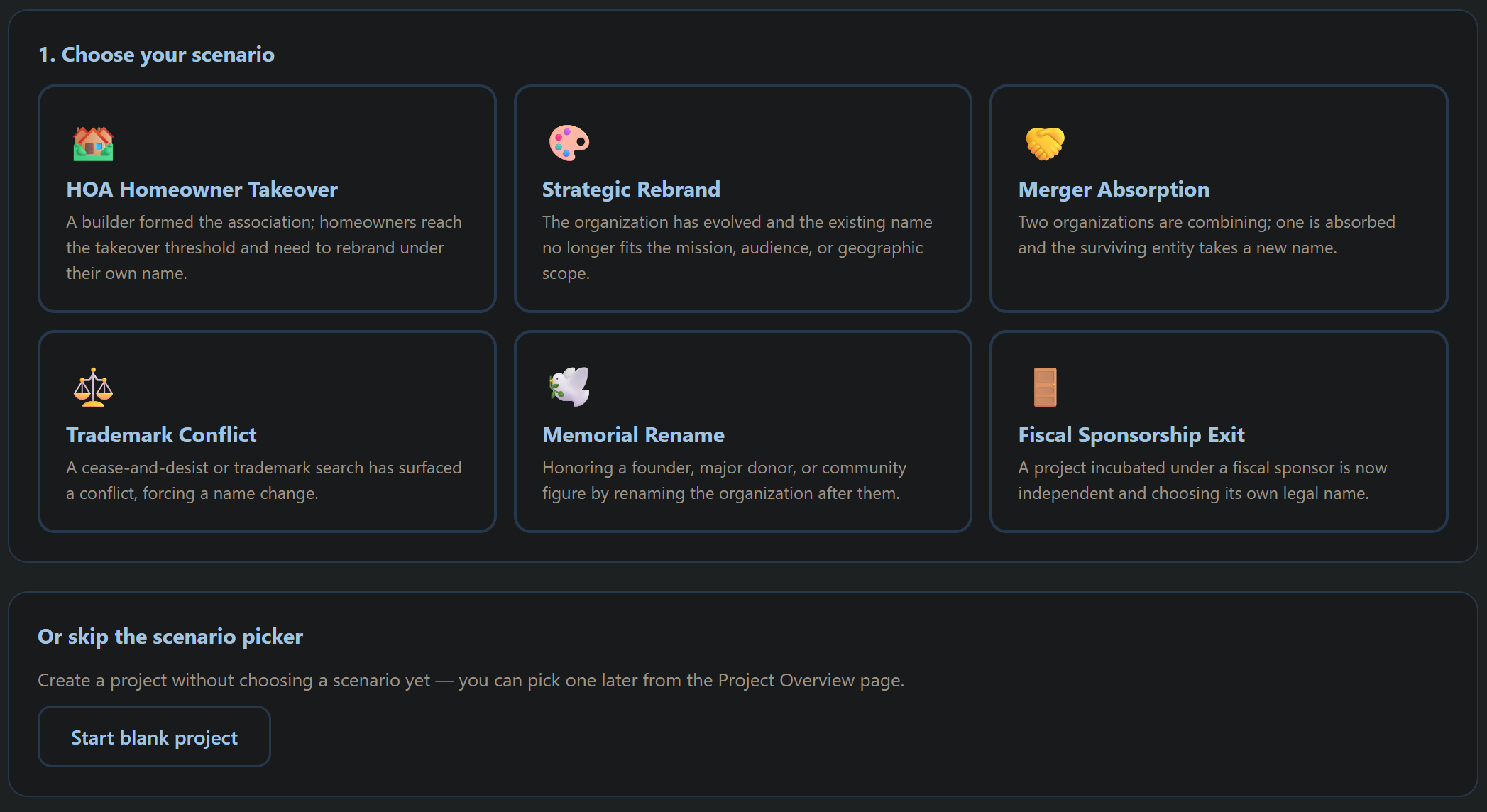
A step-by-step path for legally changing your organization's name everywhere it appears: the state, the IRS, your bank, your registrations, and your donors.
Key features
- State amendment guidance for filing your articles change.
- IRS notification steps so your exemption stays intact.
- Master checklist: bank, registrations, licenses, donors, web, and branding.
- Notification letter generators you can export and send.
How to use it
- Follow the checklist in order, starting with the state filing.
- Generate the amendment and notification letters.
- Check off each party as you notify them.
For a step-by-step first session, see the Name Change guide.
Open Name Change →Impact & Outcomes
Why it raises money: each program captures cost-per-outcome and the full picture of impact (including the dimensions organizations usually overlook), and that flows straight into your thank-yous, appeals, and grant reports in Donor Management and Fundraising and Development. Proven impact you can communicate is what earns the next gift and a renewed grant.
Each program captures cost-per-outcome (enter cost and reach, see cost per person and per outcome) and the full picture of impact through a completeness meter plus eight commonly-overlooked dimensions, with an AI gap-finder that suggests impact you have not recorded yet. Reports adapt to their audience and pair every number with a story. In Donor Management, a Stewardship plan lays out a year-round cadence for restricted-gift donors, the digest reminds you when a touch is due, and an opt-in setting (off by default) can auto-send those updates. Restricted-gift thank-yous, appeals, year-end statements, and the Fundraising and Development asks all pull the funded program's real results.
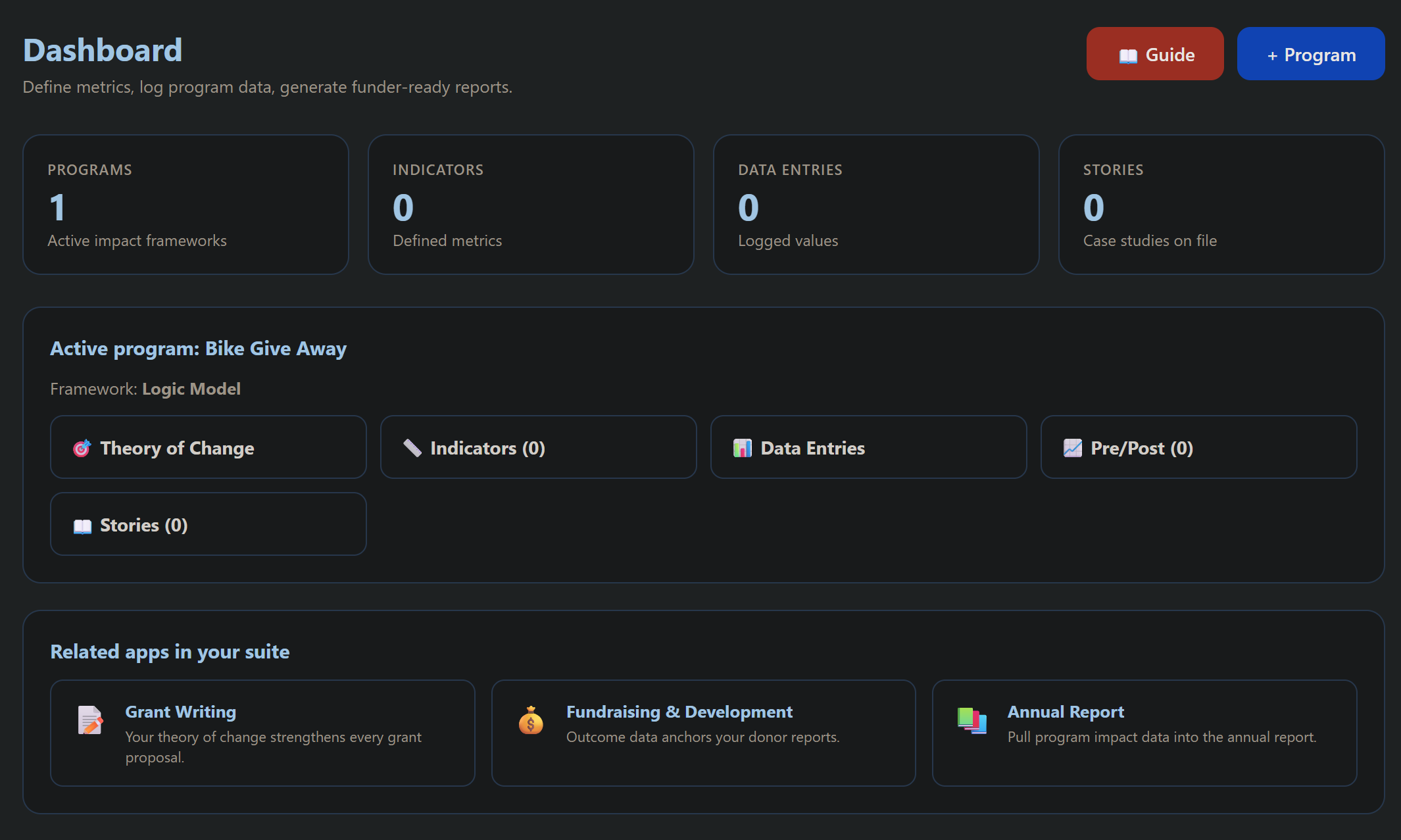
Define the outcomes your mission is meant to produce, build a logic model, and track the metrics that prove your impact to funders and your board.
Key features
- Logic model builder: inputs, activities, outputs, outcomes, and impact.
- Outcome and metric definitions tied to your programs.
- Data tracking so you can show change over time.
- Impact reporting you can export for funders and your annual report.
- Predictions (free): outcome trajectory, whether you are on pace or behind a target. See Predictions.
How to use it
- Define your intended outcomes and the metrics for each.
- Build your logic model to connect activities to impact.
- Track your data and export an impact summary when you need it.
For a step-by-step first session, see the Impact & Outcomes guide.
Open Impact & Outcomes →Membership
Run your whole membership program from one place: a member roster with an automatic six-stage lifecycle, levels and dues, renewal reminders that use your own payment link, and win-back campaigns for lapsed members.
Key features
- Member roster with a six-stage lifecycle: prospective → new → active → renewing → lapsed, plus life members, derived automatically from join and renewal dates, never set by hand. Each member can also carry a membership number (shown on the roster and in the CSV export). Life members stand outside the cycle entirely: they carry no renewal date and never receive a dues bill or a renewal reminder.
- Levels & dues: define your tiers with annual dues and expected-revenue math built in. A "Use typical levels" starter set gives you Individual, Family, Couple, Student, Senior, Associate, and Life. Each level can carry its own renewal term (anniversary, calendar year, or calendar year with an editable fall cutoff), one or more one-time fees charged at join (initiation, application), and age-banded pricing (especially for Life membership) where the joining member picks an age band that sets their price.
- Renewals with your own payment link: the app never touches your money, reminders point members to the payment link you already use, with one-click "Mark renewed" and bulk reminder sends.
- Win-back campaigns for lapsed members, plus directory and annual membership report compilers.
- Newsletter: compose and send a real email newsletter to your members through your connected email tool (MailerLite, Mailchimp, or Brevo) (see the write-up below).
- 12 AI automations: welcomes, dues receipts, renewal reminders, bulk renewal sends, win-back letters and campaign plans, event invitations, a directory compiler, and an annual membership report.
- Predictions (free): member renewal-risk plus a dues forecast. See Predictions.
How to use it
- Set up your membership levels and dues under Levels & Dues.
- Add your members to the roster, join and renewal dates drive the lifecycle automatically.
- Paste your payment link under Renewals, then let reminders, receipts, and win-backs draft themselves.
Renewal terms, fees, and pricing
Membership programs do not all renew on the same clock or charge the same way, so Levels & Dues gives you per-level control:
- Renewal term per level (and an organization-wide default): Anniversary (one year from the join date), Calendar year (through December 31), or Calendar year with a fall cutoff. The cutoff date is editable and defaults to October 1: someone who joins on or after it is covered through the end of the following year, so a late-fall join is not asked to renew six weeks later.
- One-time fees per level, charged once at join (initiation, application, badge), on top of annual dues. The Add or Edit member form also has an editable one-time fee field.
- Age-banded pricing per level, especially for Life membership: define a price for each age band (for example Under 40, 40–64, 65+) and the joining member picks their band, which sets their price.
- Membership numbers on each member, and life members who never carry a renewal date and never receive a dues or renewal reminder.
Dues Dashboard, automated reminders, and claims
The dues and renewals workflow has been upgraded so a treasurer can see who owes what at a glance and let the platform run the reminder schedule. The app never touches your money: everything here still works through your own payment link.
- Renewal cycles per level: each level sets a cycle of Anniversary (one year from each member's join date), Fixed date each year (pick a due month and day, for example December 31 for a calendar year), or Lifetime, plus multi-year terms (1, 2, 3, or 5 years) and a configurable grace period (60 days by default). A plain-language preview shows exactly when members are due and when they lapse.
- Dues Dashboard: a treasurer view listing every member sorted by next due date, each with a status color (active, due soon, overdue, paid ahead, lapsed, or lifetime), the due date and the lapse date, the last payment, and the next scheduled reminder. Filter chips with counts, header totals (expected dues, collected this year, outstanding, and collection rate), and a per-row Mark paid that records a payment and advances the renewal.
- Automated renewal reminders: the platform emails members their reminders on a fixed schedule (30, 7, and 1 day before the due date, an overdue nudge about 2 days after and then weekly, and a single lapse notice), sent from your club's name with your club's payment link. The schedule is deduplicated, so it is impossible to double-send, and a weekly treasurer digest summarizes due-soon, overdue, lapsed, and recent payments.
- Claim and confirm: every reminder includes an "Already paid another way?" link. A member who paid by check, cash, or PayPal reports it there, which pauses their reminders for 7 days and files a claim; the treasurer sees it in a new Claims queue and clicks Confirm to record the payment and advance the renewal.
- Renewal setup and migration: a one-time dry run on the Renewals page previews how every member's renewal date lines up with the level cycles and applies corrected dates only when you click Apply, so nothing changes until then.
- My memberships in the member portal: a member who belongs to more than one club sees a "My memberships" card listing every club they belong to across both Build Your Club and All In One Nonprofit, each with its own Renew button.
Public signup and committee approval
The app can publish a public join page at allinonenonprofit.com/join. On the new Applications page you choose whether people Join immediately or Require committee approval first, then click Save & publish my levels to get a shareable join link. In approval mode, applications land on a Pending applications page: your membership committee votes (majority), the committee chair finalizes, and on approval the applicant is emailed a private link to finish joining and pay any dues and one-time fees through your organization's own connected Stripe account (a polite automatic email goes out on a decline). Free levels join instantly; paid joins need a charge-ready connected Stripe, the same as online giving. Your membership committee and its chair are managed on the My Organization page (name a committee containing "Membership" and set the chair's role to Chair). Anyone on the Membership committee, the officer slate, or the board can open the Membership app regardless of their assigned access role.
Newsletter
The Newsletter page lets you compose and send a real email newsletter to your members, using your connected email tool (MailerLite, Mailchimp, or Brevo). All In One Nonprofit never owns the sending, the list, unsubscribe handling, deliverability, or CAN-SPAM compliance: your email tool does, on your account, so your newsletter follows the same rules and reputation as the rest of your email. You connect your email tool once on the My Organization page, then it is ready everywhere.
- Compose multi-section emails: a subject line, preview text, an optional header banner image (uploaded and auto-shrunk to about 1200px wide), and repeatable content sections, each with a heading, body, and an optional image you can upload per section and remove. A live Preview shows the result as you go.
- Bring your own HTML: if you would rather start from a design you already have, paste your HTML or upload an .html file and send it as is.
- Draft with AI (included): give it a few topics and it drafts the subject line and sections for you to edit.
- Saved templates, Clear and start over, and Download or Copy HTML so you can reuse a layout or paste it into your email tool by hand.
- Pick who receives it: pick a list under "Send to," or use "Build a group from your records" to one-click sync your Members, Donors, or Contacts into a list in your email tool.
- Create a draft, Send now, or Schedule through your connected email tool (drafts and scheduling are available with MailerLite; Mailchimp and Brevo support instant send). Drafts and sent newsletters live in your email tool's campaigns area.
A note on MailerLite plans: With MailerLite, sending content that All In One Nonprofit built for you through the MailerLite API requires the MailerLite Advanced plan. On the Free or Growing Business plans you can still build everything here, then use Download HTML or Copy HTML and paste it into MailerLite to send. Verified 501(c)(3) organizations get 30% off MailerLite paid plans. Mailchimp and Brevo each have their own API key settings and plan requirements.
For a step-by-step first session, see the Membership guide.
Open Membership →Financial Management
A treasurer's tool for the money side of governance: build an annual budget, keep a transaction ledger that fills itself as money arrives, see how actuals compare to your plan, and produce a board-ready financial report, so your board has clear financial oversight without a full accounting package.
Key features
- Annual budget by category: enter income and expense lines, each tagged unrestricted or restricted, and a restricted line can name which fund it belongs to, chosen from your own list rather than typed.
- Money records itself: online donations, recurring gifts, event tickets, sponsorship and auction payments, form payments, and membership dues all write their own ledger entry the moment the payment is taken, and cash and checks recorded in Donor Management book too. Each entry records the gross income and the real processing fee as a separate expense, read back from Stripe rather than estimated, so the books match the bank. Refunds add a reversing entry instead of deleting anything.
- Restricted funds tracked on both sides, fund by fund: the Funds card shows income, spend and what remains for each named fund, not just for restricted money in aggregate, and warns when a fund has been spent beyond what came into it. That warning is per fund on purpose, because a surplus in one fund hides a deficit in another and the total keeps looking healthy while it happens. The board report and the AI treasurer's narrative carry the same figures.
- Automatic entries are marked as such: an Automatic badge in the ledger, a filter for All, Automatic only, or Entered by hand, and a Recorded By column in the CSV export so the distinction survives outside the app.
- Transaction ledger with CSV import: record your other income and expenses as you go, or paste or upload a CSV (it needs a Date and an Amount column) to bring in actuals in bulk.
- Budget-versus-actuals dashboard and a simple income statement: see income, expenses, and net at a glance, with each budget line matched to its actuals and any unbudgeted activity surfaced.
- Fiscal-year settings: set your fiscal-year start month and current year so everything rolls up to the right period.
- Board financial report: generate a report you can download as PDF or Word, print, or save to your Document Library, on your letterhead if you have set up document branding.
- Three AI automations: a Treasurer's Board Narrative, a Budget Drafter, and a Financial Health and Variance Review.
- Course Modules: a short nonprofit-finances course with quizzes, plus the standard Organization Settings and document branding.
How to use it
- Set your fiscal-year start and year, then build your budget under Budget (income and expense lines, with the fund tag).
- Connect Stripe on My Organization and the money you collect starts booking itself. Add your other transactions, or import a CSV of actuals, and watch the dashboard fill in budget versus actuals. Export the ledger back to CSV anytime from the Ledger card.
- When the board meets, open Board Report, draft the narrative with AI if you like, and download, print, or save it to your Document Library.
For a step-by-step first session, see the Financial Management guide.
Open Financial Management →Executive Director & Board Apps
Role-by-role playbooks for the people who run the organization: the Executive Director and each board officer.
Executive Director
An interactive app for running the executive director role: guided worksheets you fill in and save, AI drafting for your most time-consuming documents, a built-in course, and a month-by-month operating cadence calendar, all in one place.

Key features
- Saved worksheets for the work that matters: First 90 Days, Annual Work Plan & Goals, Strategic Plan Builder, Annual Operating Plan, Continuity & Succession, Operating Rhythm Planner, Board Chair 1:1 Agenda, Key Conversations, and an ED Self-Evaluation. Each has a notes box after every question and saves in your browser so you can come back and update it.
- Strategic Plan Builder that compiles a board-ready plan: enter your mission, vision, and three to five priorities, and it assembles one plan with your annual goals (drafted by AI from the priorities), how progress will be measured (your Impact and Outcomes indicators), budget alignment (pulled automatically from your Finances app), strategic risks (pulled automatically from your Risk Management app), and a governance and adoption section. Leave the budget and risk fields blank to auto-pull, or type your own to override. From the plan window you can polish the whole thing with Improve with AI or send it to the board for e-signature adoption with Send for board adoption.
- Getting Started checklist: a "Getting Started" item at the top of the sidebar opens an interactive 10-step start-here list (join your team, take the tour, First 90 Days, a board chair 1:1, the course, your work plan and cadence calendar, branding, evaluation timing, and continuity) with your progress saved as you go, so a new executive director knows exactly what to do first.
- Cadence Calendar built in: a month-by-month operating rhythm you can export to your own calendar.
- AI Automations: draft a board report, annual goals from your strategy, a self-evaluation narrative, talking points for a hard conversation, a 90-day plan, an ED job description, or a new-ED welcome. Each opens as a document you edit and export to Word, text, print, or email. The board report drafter now weaves in your real measured program impact (cost per outcome and results) from the Impact & Outcomes app when you have captured it, so it cites real numbers instead of placeholders.
- Employee Reviews: run annual employee reviews and contractor evaluations (owner or org Admin). Employees complete a five-question self-review from the member portal, you compile it into your manager worksheet with AI (approving each field before anything is written), draft the formal summary with AI, and export it to Word on your letterhead; contractors get a manager-only evaluation scored against the contract's requirements. The same review records are shared with the HR Management app.
- Course Modules: a short executive-director leadership course with quizzes.
- Organization Settings: save your name, organization, letterhead, footer, and signature once and they apply to every document you export.
How to use it
- Open Organization Settings and enter your name, organization, and letterhead.
- Start with the First 90 Days or Annual Work Plan worksheet, fill it in, add your notes, and save.
- Use the Operating Rhythm Planner and Cadence Calendar to build your year, then open AI Automations to draft a board report or other document and export or email it.
For a step-by-step first session, see the Executive Director guide.
Open the Executive Director app →Board Officers
One interactive app for all four officer roles. Pick a role, President or Chair, Vice President, Secretary, or Treasurer, and get worksheets, AI drafting, and a course tailored to that seat.

Key features
- Role selector drives everything: choose President/Chair, Vice President, Secretary, or Treasurer and the whole app tailors to that role.
- Getting Started checklist per role: a "Getting Started" item at the top of the sidebar opens an interactive, role-specific start-here checklist, from joining the team and signing your role agreement to the course module and the tools that seat actually uses (for a treasurer, the Budget Builder, Budget vs Actual, Board Report, Compliance Tracker, and IRS Forms 990), each step deep-linking to the right place, with progress saved as you go.
- Saved worksheets: Officer Onboarding Kit, Role Agreement (signable), Role Duties & Focus, and a Succession Plan, each with a notes box and saved in your browser.
- AI Automations for any role: a welcome letter, a tailored role description, an onboarding plan, a succession brief, a transition memo, an outgoing-officer thank-you, and a new-officers announcement. Edit and export to Word, text, print, or email.
- Course Modules: an officer-focused course with quizzes.
- Organization Settings: save your organization and current officers once; pick a role in any tool and it fills in that officer's name.
How to use it
- Open Organization Settings, enter your organization and your current officers by role.
- Pick a role in any tool to auto-fill the officer's name, fill in the worksheet, and save.
- Use AI Automations to draft the documents that role needs, then export or email them.
For a step-by-step first session, see the Board Officers guide.
Open the Board Officers app →Operations & Compliance Apps
Keep the organization running and in good standing: operations audits, filing calendars, document retention, HR, and your technology setup. (Your annual Form 990 return is prepared in the IRS Forms Assistant.)
Operations Audit
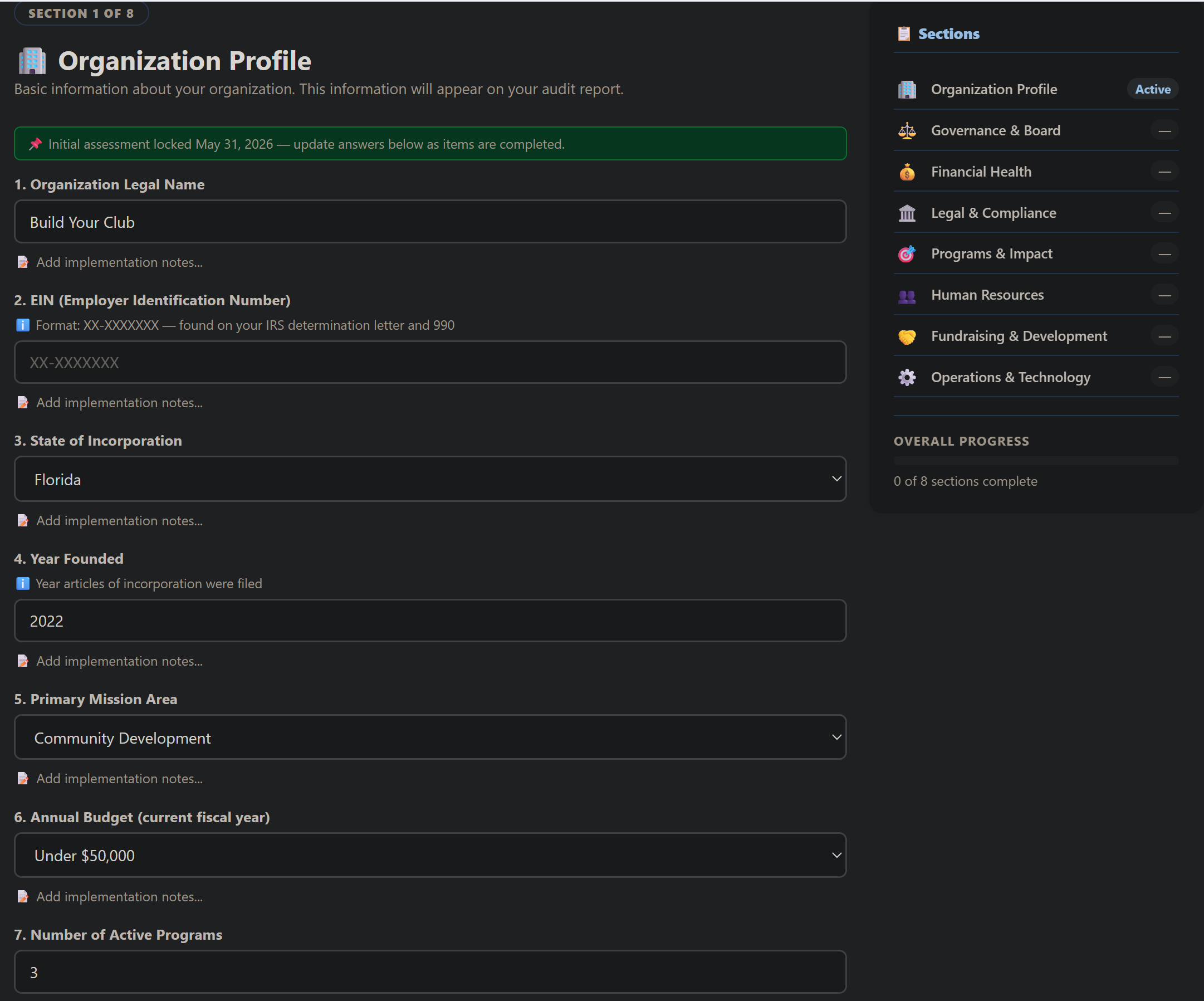
A guided self-audit of your nonprofit's operations that scores your health across the areas that matter and hands you a prioritized action plan.
Key features
- Multi-section assessment across governance, finance, operations, HR, and compliance.
- Scoring that shows where you're strong and where you're exposed.
- Prioritized recommendations tied to the tools that fix each gap.
- Exportable report to share with your board.
- Predictions (free): capacity risk by audit area, surfacing low or declining scores. See Predictions.
How to use it
- Answer the assessment honestly, section by section.
- Review your scores and the prioritized recommendations.
- Export the report and work the list with the linked tools.
For a step-by-step first session, see the Operations Audit guide.
Open the Operations Audit →Compliance Tracker
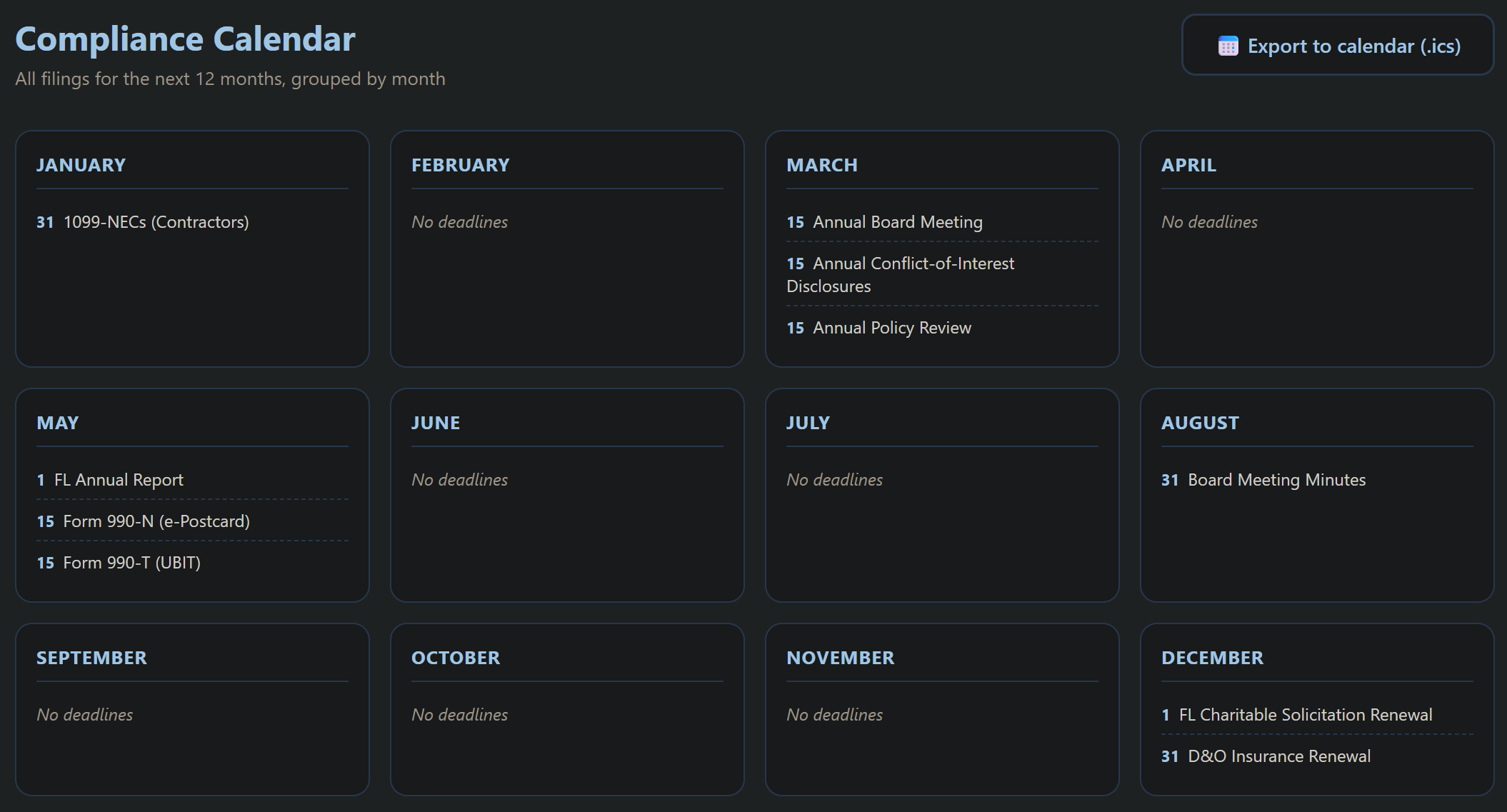
A federal and multi-state compliance calendar that tracks the deadlines that keep you in good standing: the 990, state registrations, and charitable solicitation renewals.
The tracker shows only the filings you actually owe, based on the two questions you answer once on the My Organization page: what kind of organization you are, and how the IRS classifies you. A church, integrated auxiliary, or convention or association of churches is exempt from the annual return under IRC 6033(a)(3)(A)(i), so the whole 990 series is removed and a notice explains why (the three-year automatic revocation rule does not reach them either); churches also get a tracked annual deadline for the minister’s housing allowance designation, which must be adopted by the board before January 1 and can never be backdated, and anyone unsure whether they count as a church can take the guided 14-factor church check first. A homeowners association electing section 528 is pointed to Form 1120-H instead of a 990, and an organization that is not yet exempt is not shown the 990 series at all. Booster clubs, PTAs and PTOs, and sports leagues that are 501(c)(3) also get a caution, and an annual Fundraising Allocation Review item, about crediting fundraising to individual families, which is the most common way those groups lose their exemption.
Key features
- Deadline calendar for federal and state requirements.
- State-by-state registration and solicitation tracking.
- Status and reminders so you know what's done and what's due.
- Per-filing tracking: expand any filing to set a custom due date (honored by the calendar and score), name a responsible person, and keep notes, with plain-English explanations under jargon terms like the URS and audit thresholds.
- A record of every filing: expand a filing and record the date it was filed, who filed it, the agency’s confirmation number, and the proof itself, which uploads straight into your Document Library and is tagged so you can pull up every year at once. The record is kept on your organization’s account, so it survives a new laptop and a change of treasurer.
- Last year is never overwritten: each record is filed against the year it covers, so when a deadline rolls forward the previous year moves into Earlier filings kept on record, with its date, its filer, its confirmation number and its evidence intact. That is what lets you show a board or an auditor not just what is due, but what was actually done.
- Your own deadlines: add anything the built-in rules cannot know about, a grant report, a lease renewal, an insurance certificate, a local permit. It joins your filing list and your calendar feed and gets the same record panel, so your own deadlines build the same history as the required ones.
- Independent audit check that reads your state's audit threshold against your revenue to flag whether an audit, review, or compilation is likely required (plus the federal Single Audit and funder triggers), with an audit-readiness checklist and an Audit Readiness Plan automation.
- Predictions (free): deadline-miss risk for your filings. See Predictions.
How to use it
- Set your state(s) and confirm which requirements apply.
- Review upcoming deadlines and mark filings as complete.
- When you file something, record it: the date, who filed it, the confirmation number, and the proof.
- Check it on a regular cadence so nothing lapses.
For a step-by-step first session, see the Compliance Tracker guide.
Open the Compliance Tracker →Document Retention & Security
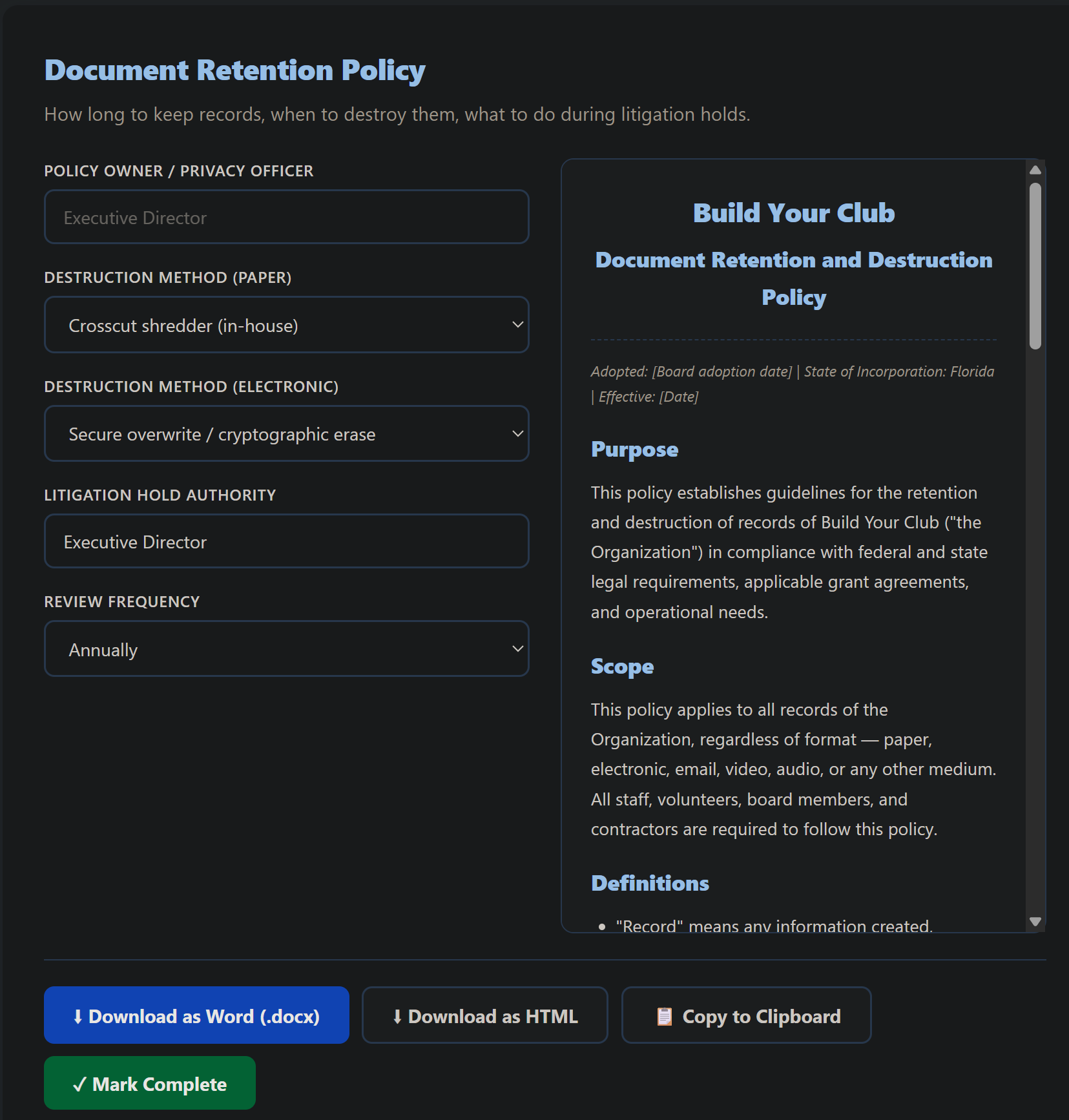
Generate the document-retention and data-security policies a nonprofit should have, plus a clear schedule for what to keep and for how long.
Key features
- Retention schedule: what to keep, and for how long.
- Policy generators: document retention, privacy, and data security.
- 5 AI automations: an AI Acceptable Use Policy, a Third-Party & AI Vendor Vetting Policy, a Social Media Policy, a BYOD & Remote-Work Device Policy, and a Policy Binder Compiler.
- Word export on your letterhead, ready to adopt.
How to use it
- Generate the retention schedule and policies.
- Customize them to your organization.
- Export to Word, adopt by board resolution, and file.
For a step-by-step first session, see the Document Retention & Security guide.
Open Document Retention & Security →HR Management
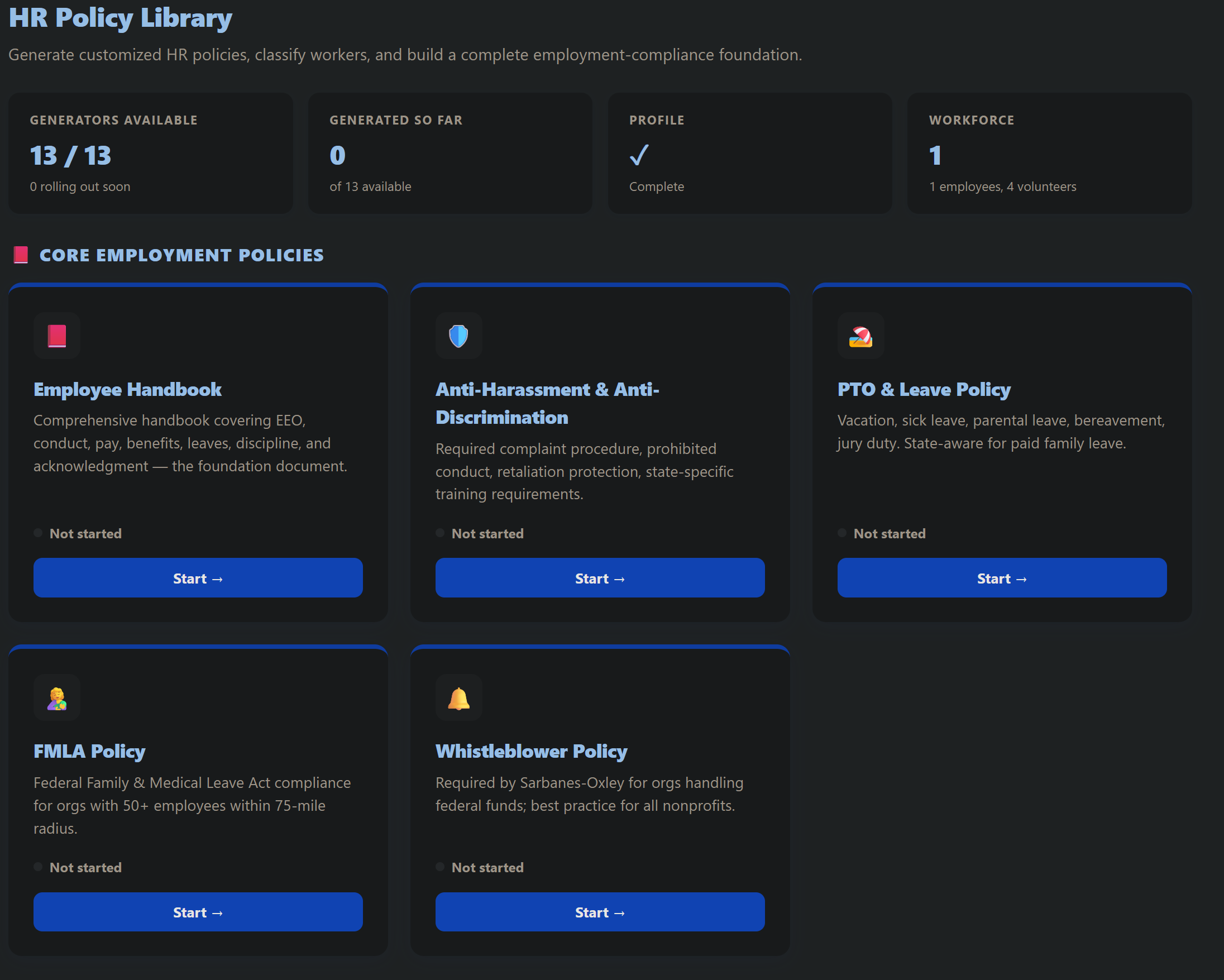
The HR essentials for nonprofits: employee versus contractor classification, an employee handbook, offer letters, and the core policies you need before you hire.
Key features
- Employee handbook generator with the core policies.
- Classification guidance: employee vs. independent contractor.
- Offer letters and onboarding documents.
- Employee Reviews and contractor evaluations: request a five-question self-review that the employee completes from the member portal (an email plus a portal alert, with an AI writing coach that turns rough notes into drafts they approve), compile it into your manager worksheet with AI (per-field approval), draft the formal review summary, export to Word on your letterhead, and mark it complete to set the next review date a year out. Contractor evaluations score the work against the contract's requirements (upload or paste the contract and AI proposes the checklist for your approval) and record a renew, renegotiate, rebid, or end recommendation. Shared with the Executive Director app, both work from the same records.
- Payroll & Labor Allocation: import the payroll register CSV from the system you already use (Gusto, ADP, Paychex, QuickBooks, and the rest) or enter a pay period by hand, split each person's cost across your programs, grants, and funds, and produce the labor cost allocation and personnel-cost reports funders and auditors ask for, plus an on-screen labor dashboard, an AI-drafted personnel-costs narrative (only the computed numbers, never invented), and a 12-item payroll compliance checklist. It does not run payroll, file taxes, or move money; it allocates and reports on the payroll you already run.
- ⛪ Clergy Compensation (churches): a church-only section for the rules that make minister pay different. The least-of-three housing allowance worksheet (designated amount, actual costs, fair rental value) with both resulting tax bases shown, since the exclusion applies for income tax but stays in the SECA base; a designation record that refuses retroactive effective dates, because the allowance must be designated in advance by board action; minister payroll flags (dual status, FICA exempt, voluntary withholding, the irrevocable Form 4361 deadline); W-2 guidance for the boxes that differ; and the reminder that churches owe no FUTA on any employee. Structures, calculates, and documents; your CPA confirms the numbers. See Using the Platform as a Church.
- Credentials & CEUs: track the professional development your people earn outside the platform, continuing education units, certifications, professional licenses, and outside courses, per staff member (and board members or volunteers by name), with the issuer, completed date, hours, an optional renewal date, and a link to the certificate. Totals your CEU hours, flags anything expiring within 60 days or already expired, and exports to CSV for grants, audits, and accreditation. Upload the certificate file straight into your Document Library, set an annual CEU-hour goal (a default for everyone plus per-person overrides) and watch each person's progress bar, and use Draft report (AI) to turn the records into a written professional-development and compliance report. People can log their own credentials from the member portal (you confirm each with one-click Verify), renewal dates flow into your calendar feed and weekly digest, and the same records surface in the Volunteer Management and Board Management apps matched to your volunteers and board. For clubs it doubles as volunteer and coach compliance tracking (background checks, SafeSport, first aid and CPR, concussion, coaching certifications).
- Word export on your letterhead.
- Sidebar layout: the app's screens sit in three short groups, PEOPLE (Employees, Time Off, Reviews, Credentials & CEUs), PAY & CLERGY (Payroll, and Clergy Compensation for churches), and POLICIES & COMPLIANCE (Core Policies, Hiring & Onboarding, Separation & Volunteers, Compliance Tools), matching the layout of every other app.
How to use it
- Generate your handbook and core policies.
- Use the classification guidance before you engage someone.
- Export offer letters and onboarding docs as you hire.
For a step-by-step first session, see the HR Management guide.
Open HR Management →Forms
Build a custom form, hand out one permanent link, and stop chasing paper: responses collect themselves, and a scheduled report turns them into a summary your team and your board actually read.
Key features
- Form builder for sign-ups, daily activity logs, intake forms, and surveys, with text, choice, date, and number fields (numbers are validated on the phone and the server).
- One permanent public link per form that opens on any phone with no login and no app; volunteers can add it to their home screen once and it works like an app from then on.
- Responses in one place: every submission on one screen, with paging for large forms and a CSV export for spreadsheets. The CSV always contains every response, not just the page on screen.
- Answers survive being interrupted: a long form saves itself on the person's own device as they type and restores if they close the page by accident, then clears once they submit. Nothing to switch on.
- Scheduled summary reports: a weekly, monthly, quarterly, or annual email to any recipient list with the key figures, per-field breakdowns, and notable comments from the period, written in plain language.
- One-click board report: the same summary as a Word document on your organization letterhead, ready to download, save to the Document Library, print, or email as an attachment.
How to use it
- Build the form and share its public link once, by text or a printed card.
- Watch responses collect on the Responses screen; export CSV when you need a spreadsheet.
- Switch on a scheduled summary so the totals arrive by email without anyone compiling them.
- Before a board meeting, generate the board report on letterhead in one click.
Technology & Digital Services
Get your nonprofit's technology in order without an IT department: assess where you stand, set up a proper website and professional email, claim the free nonprofit tech programs, lock down security, and plan your tech budget for the year.
Key features
- Tech Readiness Assessment that grades your current setup and produces a prioritized report.
- Website builder and domain guidance, plus professional email setup (Google Workspace or Microsoft 365).
- Free & discounted nonprofit tech programs, what to claim and how.
- Security essentials: passwords, MFA, backups, and account hygiene.
- Annual tech plan and budget sized for small organizations.
How to use it
- Run the Tech Readiness Assessment to see where you stand.
- Work the fixes in priority order, website, email, security.
- Build your annual tech plan and budget from what's left.
Communications
- Connect your own email tool (MailerLite, Mailchimp, or Brevo) to send email from your organization.
- Organization Contacts list for vendors, contractors, partners, and other non-donor contacts, with a contact person (who to ask for), a type pull-down, tags, phone, and address on each record. Email is optional, so phone-only contacts save fine.
- Contact Manager: the same contacts, plus your donors and volunteers, in one searchable list at www.allinonenonprofit.com/contact-manager/ where you can log calls, set follow-ups, and schedule tasks and appointments. This address book keeps working and stays in sync.
- Import contacts from a CSV file: click Import CSV in the Organization Contacts address book (or use the Import contacts screen in the Contact Manager) to bring in a list at once. Column headers are auto-mapped (Name, Contact Person, Email, Phone, Type, City, Zip, Tags, Notes), you see a preview of new versus updated rows first, rows with a matching email update instead of duplicating, and the whole batch can be undone in one click. An Export CSV button downloads your contacts back out to a spreadsheet.
- Branded invitations and updates sent to chosen audiences from your contacts.
For a step-by-step first session, see the Technology & Digital Services guide.
Open Technology & Digital Services →Fundraising & Development Apps
The full fundraising lifecycle: a strategy course, donor and gift tracking, marketing, grants, and your annual report.
Fundraising & Development
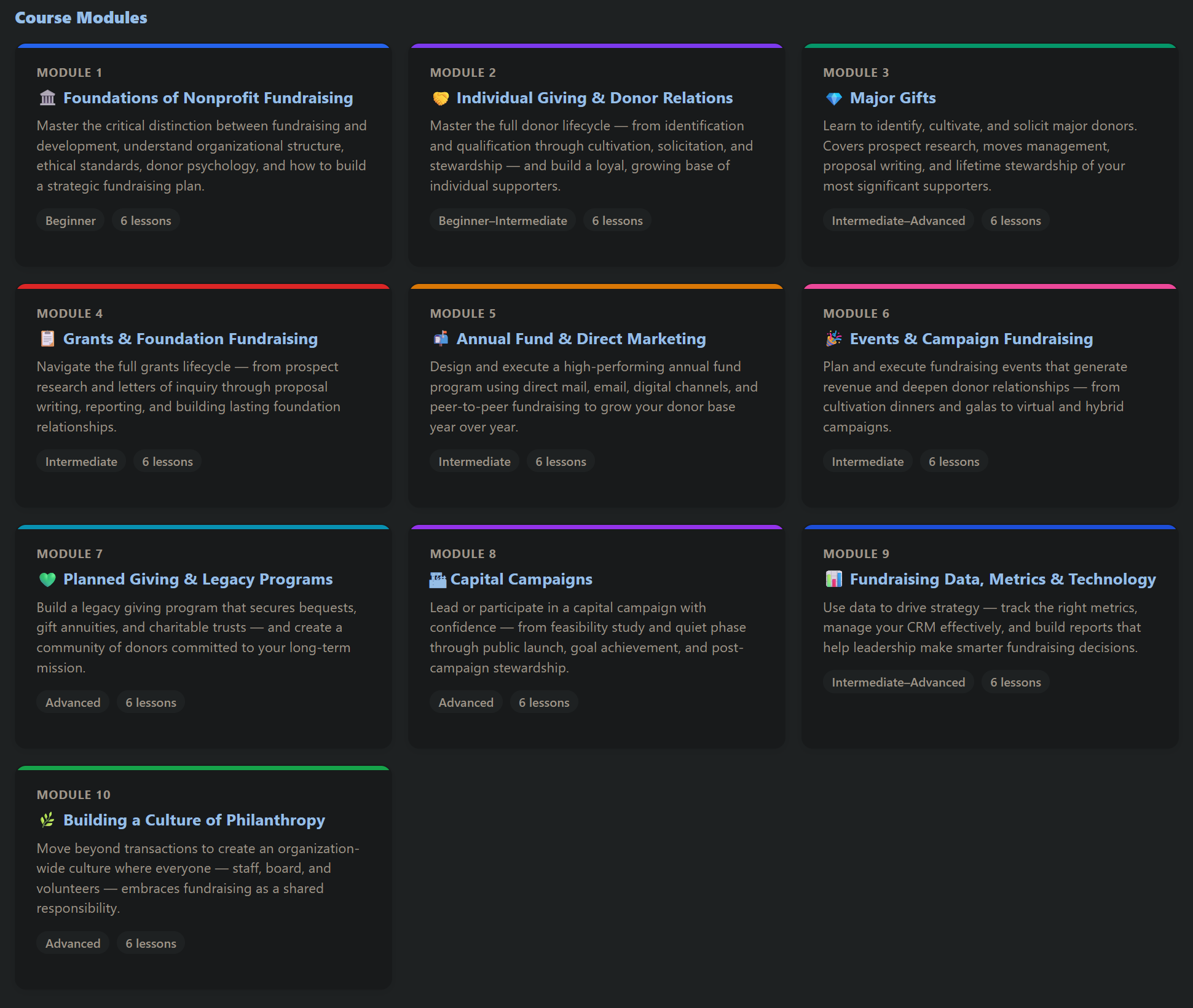
A practical fundraising course paired with planning tools and AI drafting: build annual plans, donor pipelines, appeals, events, and grants, then let AI draft the plans and documents, for organizations that have to raise the money themselves.
Key features
- Self-paced course on strategy, the donor lifecycle, and asking, with notes and progress you can mark complete.
- Annual fundraising plan framework.
- 9 AI automations: annual development plans, campaign plans, gift range charts, readiness assessments, and fundraising calendars.
- Predictions (free): a grants pipeline forecast and deadline risk. See Predictions.
- Connects to the Donor Management, Grant Management, and Marketing tools.
How to use it
- Work through the lessons and build your annual plan.
- Use the AI automations to draft your development plan, campaign plans, and fundraising calendar.
- Put the plan into action with the connected development tools.
Campaigns & appeals tracker
- Plan and track each campaign or appeal from the Campaigns & Appeals item in the Develop sidebar group: give it a name and type, set a goal, and record the cost, the amount raised, the number of donors, dates, owner, and status, with a live progress bar on each campaign card.
- Link the plan document: a "Plans and appeals in your Library" panel lists documents in your Document Library tagged campaign or appeal, so you can classify a document into a campaign and start a campaign entry pre-filled from a saved plan, and each campaign card can carry a linked-plan URL.
Events & ticketing
- Create and edit events with the details, date, and capacity for galas, workshops, and fundraisers.
- Ticket types with prices, plus promo codes for discounts and comp codes for free admission. Quick-add ticket-type presets (General Admission, VIP, VIP Table, Complimentary, or your own) let you add common ticket types in one click.
- Public RSVP and registration page you can publish and share so guests can sign up.
- Paid tickets sold through your organization's own connected Stripe account, so funds go straight to you.
- Attendee roster with check-in to manage and admit guests at the door.
- QR tickets and a door scanner: each ticket gets a branded "Admit one" page with a scannable QR code (paid-ticket confirmation emails include a link to each ticket), and a mobile Check-in scanner button on the roster opens your phone camera to scan guests in at the door, showing each guest's name and ticket type and whether they were already checked in.
- Cancel an event and automatically refund all paid attendees through Stripe.
- Per-ticket fair-market-value so receipts reflect the quid-pro-quo, tax-deductible portion of each purchase.
- Send invitations with a composer that emails a chosen audience through your connected email tool (MailerLite, Mailchimp, or Brevo).
Event sponsorship tracking
- Sponsors on every event: open Events, then the Sponsors button on an event to manage that event's sponsors in one place.
- Per-sponsor detail: track each sponsor with name, level or tier (Presenting, Gold, Silver, Bronze, In-kind, or a custom tier), committed and paid amounts, status (Prospect, Committed, Paid, or Declined), contact, a benefits and recognition checklist (one item per line, ticked off as you fulfill each), notes, and a logo.
- Per-event totals and what is owed: see committed and paid totals for the event, plus a What is still owed view that lists every unfulfilled benefit across all sponsors.
- Across-events roll-up: the Corporate and Sponsors sidebar item shows totals, a by-event breakdown, and your top sponsors across all events.
- Recognition PDF: a Recognition PDF button builds a designed sponsor wall grouped by tier (with logos) that downloads and files itself into your Document Library.
- AI sponsorship-ask drafter: a per-sponsor AI button writes a tailored sponsorship request letter.
Team fundraising (peer-to-peer)
- Create a campaign with a name, goal, story, and dates, then add individual fundraisers (board members, volunteers, and supporters) from the Team Fundraising item in the Develop sidebar group.
- Shareable personal pages: each fundraiser gets their own page at app.allinonenonprofit.com/fundraise/<slug> with a personal goal and a live progress bar.
- Gifts roll up automatically: donations made through a fundraiser's page are credited to that person and add to the campaign total, working automatically with your built-in Stripe online giving, with a manual amount-entry fallback for PayPal or offline gifts.
- Use it for runs, walks, challenge events, and giving days, where you want to activate supporters as fundraisers.
Silent auction catalog
- Auction items per event: open Events, then the Auction button on an event to build a catalog of items with a name, description, donor, fair-market value, and starting bid.
- Winners and payment status: record each item's winner (name, email, and winning bid); the item moves through Open, Won, and Paid, with header totals for items, items won, amount raised, amount collected, and amount still outstanding.
- Collect the winning bid: when online payments are connected, copy a winner pay link that runs the charge through your organization's own Stripe account and marks the item paid (it records as a gift, the same path as sponsor payments). Coordinators can run the bidding manually with bid sheets; the catalog tracks the results either way.
- Export results: a CSV of every item and winner, including an "Amount over fair-market value (deductible)" column for receipting, and auction revenue also flows into the event accounting export.
Donor fee-cover and mobile giving QR codes
- Donors can cover the processing fee: your donation page and each team fundraiser page offer an optional checkbox so a donor can add the card processing fee on top of their gift, so your organization receives the full intended amount. The donor's intended gift is what is recorded and receipted; the small covered fee is shown separately in the thank-you email and the owner notification.
- Branded "Scan to give" QR codes: generate a printable QR code that points to your donation page or a specific team fundraiser page, with a label, a download as PNG, and a print view, so supporters can give from a phone at an event, on a flyer, or on screen. A QR code link sits next to each team fundraiser and on your Donor Management donation settings.
For a step-by-step first session, see the Fundraising & Development guide.
Open Fundraising & Development →Donor Management
A lightweight donor and gift tracker: keep your donor records, log gifts, segment your supporters, and generate thank-you and acknowledgment letters on your letterhead.
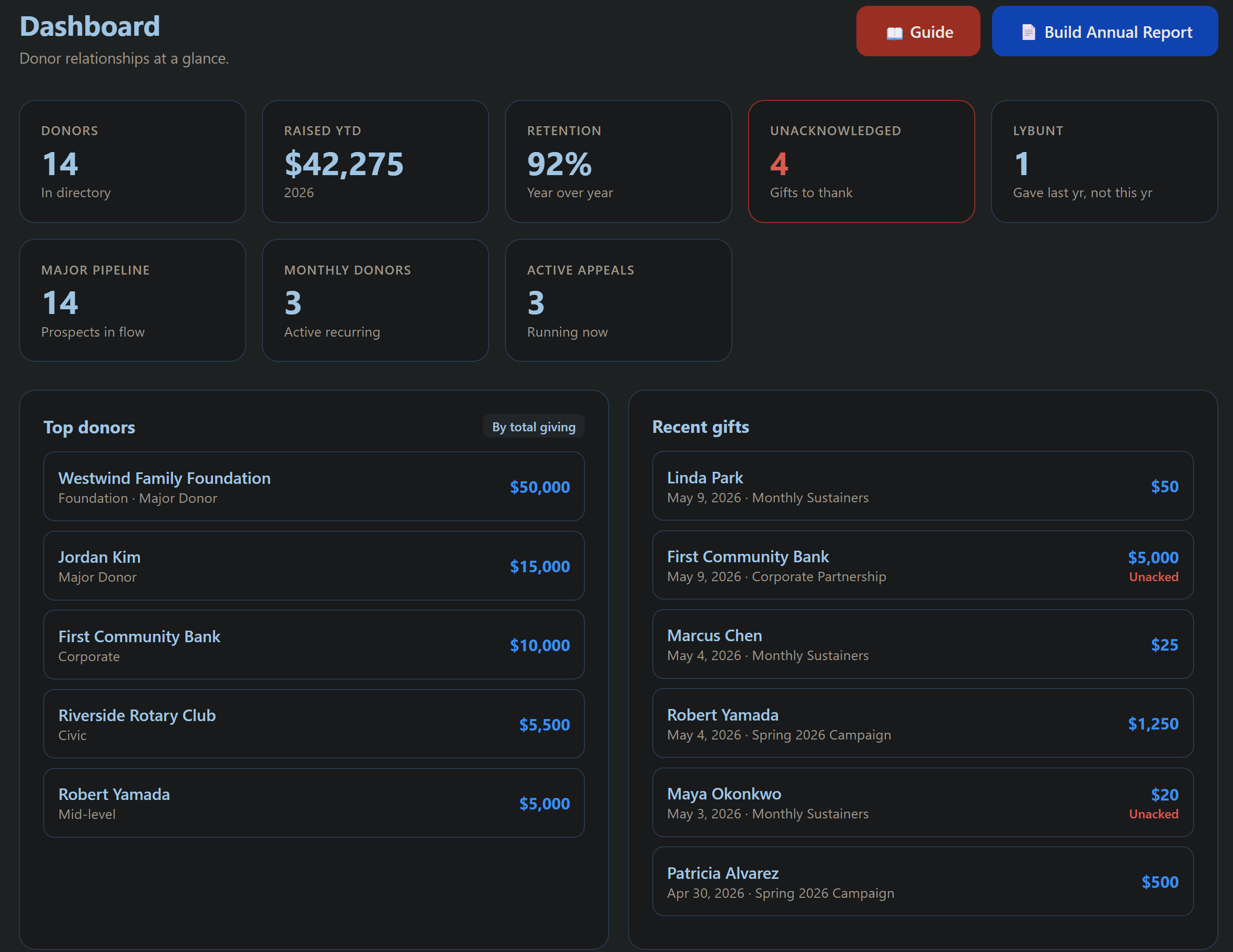
Key features
- Donor records with contact info and giving history.
- Gift logging and running totals. A gift you log by hand, a check or cash in an envelope, also writes an entry in Financial Management, so the money in the CRM and the money in the books are the same money.
- Giving funds a donor can choose from: name the funds you want offered, each with a short donor-facing explanation and a tick for whether gifts to it are genuinely restricted. The picker stays hidden entirely while your list is empty, donors choose from the list rather than typing, and the fund travels with the gift onto the acknowledgment and into the ledger.
- Segments to group and target supporters.
- Event History (in the Engagement group): a CRM archive of past events and who attended. Each event shows its date, type, attendee count, and total raised, each attendee links to the constituent, and each donor's record gains an Events attended section that is also included in the Word donor profile-sheet export. To run a live event with online ticketing and check-in, use the Fundraising and Development app.
- Acknowledgment and thank-you letters on your letterhead, with reporting and export.
- Accounting export with net-asset restriction: the gift CSV export (and the matching Membership dues and event-ticket exports) carries a Restriction column with the FASB ASC 958 net-asset class (Without donor restrictions, With donor restrictions, or With donor restrictions, permanent), so restricted and unrestricted revenue import into QuickBooks, Xero, or Aplos without re-keying.
- Predictions (free): donor lapse-risk plus giving-capacity and who is ready to be asked to upgrade, each score showing the factors behind it. See Predictions.
- Import from another CRM: a guided wizard brings your donor records and full giving history over from Bloomerang, DonorPerfect, Neon CRM, Little Green Light, or Kindful (see below).
- ⛪ Church & faith-based giving: when your organization type is Church or faith based, the app adds offering envelope numbers on each giver’s record (with duplicate checking), an Offering count batch-entry screen on the Gifts page for the Sunday plate (envelope number and amount per row, the giver’s name resolving as you type, loose offerings handled, every line saved as a normal gift), and a point-of-entry caution when a gift looks directed to a person rather than the ministry, since a love offering or wedding fee is taxable compensation to that person under IRS Publication 517. See Using the Platform as a Church.
- Import history and events: a companion wizard that finishes a migration by bringing over recurring gifts, open pledges, and event attendance history from CSV files. Each row is matched to the right constituent automatically by donor ID, then email, then name, with a column-mapping step, a dry-run preview, and one-click undo.
- Your data lives in your account: donor and gift records are stored securely on the server, so they are the same on every device your team signs in from and are backed up, not stuck in one browser.
- Install it on your phone: works offline once installed, with optional push notifications for gifts to thank and pledges coming due.
How to use it
- Add your donors and log their gifts.
- Segment supporters for appeals and stewardship.
- Generate acknowledgment letters and export your reports.
Import from another CRM
Moving from an association system rather than a donor CRM? MemberClicks is now one of the systems in the wizard, and because those systems are member-first, the roster goes into the Membership app first and giving history follows here. There is a step-by-step guide at allinonenonprofit.com/switch/memberclicks. Whatever system you are leaving, every importer shows a mapping screen listing your own column headers with a sample of the data in each one, and offers a downloadable sample CSV, so your export never has to match our column names.
Switching to All In One Nonprofit from another donor CRM does not mean starting over. The Import from another CRM sidebar item runs a guided migration wizard with built-in export guides for Bloomerang, DonorPerfect, Neon CRM, Little Green Light, and Kindful (plus a generic Other CSV option). Pick your current CRM and follow its export guide, upload your donors CSV (and, optionally, a separate gifts CSV), let the columns auto-map to the right fields (adjusting any you want), review a preview showing how many donors are new versus already in your account and how many gifts will import, then import with one click. A one-click Undo removes the whole batch if you need it, and the wizard de-duplicates by the source CRM's donor ID and then email, so importing the same file twice never creates duplicate donors. This wizard brings over donors and past gifts; a companion Import history and events wizard then brings over recurring gifts, open pledges, and event attendance history (matching each row to the right constituent by donor ID, then email, then name, with a mapping step, a preview, and one-click undo). Household relationships and custom fields are not rebuilt yet. Importing is included in your subscription.
For a step-by-step first session, see the Donor Management guide.
Open Donor Management →Contact Manager
Every person your organization touches, in one searchable list: your own contacts, plus your donors and volunteers, who show up automatically. Log the call, set the follow-up, schedule the pickup, and see giving and volunteer history right on the record.
Key features
- One list for everyone: contacts (partner agencies, funders, businesses, vendors, board contacts, and more), donors, and volunteers, each labeled by what they are. Donors and volunteers are read live from their own apps, so nothing is retyped and nothing moves.
- Interaction logging: log a call, email, text, meeting, or note on any person in seconds, with an optional follow-up date. The Follow-ups screen keeps everything you promised to come back to, oldest first, until you mark it done.
- Tasks and appointments: a dedicated screen for everything open, plus a quick-add on every person record, so "drop off at the pantry Tuesday 10 AM" lives on the pantry's record. Appointment invites carry the time zone, so someone in another state sees the correct local hour rather than the same numbers on a different clock.
- History on the record: open a donor and see their gift count, lifetime total, and recent gifts from Donor Management; open a volunteer and see their logged hours the same way.
- Rich contact records: a contact person line (who to ask for at an organization), a type pull-down, comma-separated tags, phone, email, address, and notes. Email is optional, so phone-only contacts work.
- CSV import with undo: upload a spreadsheet, headers are auto-mapped, you see new-versus-updated counts before anything is written, and the whole batch can be undone in one click.
- Follow-up and catch-up drafting with AI: on any person's record, Draft a message with AI writes the next message from what is already logged. Choose the channel (email, a phone call plan, or a text) and the purpose (follow up, catch up, thank, ask, or confirm), and it drafts from that person's calls, emails, open follow-ups and tasks, and any giving or volunteer history. It is held to the record: it will not invent a conversation, a promise, a gift, or an amount, and it leaves a bracketed placeholder where a detail is missing rather than guessing. Drafts copy, download as Word or plain text, print, or send by email from the panel.
- A guided tour built into the app: Take the tour, in the Learn and help group, walks the screen in twelve short steps and remembers where you stopped.
- Included for every organization, with a tile on the My Apps page. The contacts address book in the Technology app edits the same list and keeps working.
How to use it
- Open it from My Apps (Fundraising & Development group) and search anyone by name, email, phone, city, type, or tag.
- Log interactions as they happen; add a follow-up date whenever you promise to call back.
- Start the week on the Follow-ups and Tasks & appointments screens.
- Bring in the rest of your contacts with the CSV importer.
- When you are not sure how to open the next conversation, use Draft a message with AI on the person's record and edit what it gives you.
Case Management
For organizations that serve people directly: a food pantry, a shelter, a family services agency, a scholarship or after school program. It holds the people you serve, the cases you have open for them, the notes your staff write, and a log of what you actually delivered. That last piece is what most small organizations are missing when a funder asks what their money bought.
Key features
- Held tighter than any other app, on purpose: being a member of your organization is not enough to open it. Only the owner, a member you have marked Admin, or a member whose custom access list names Case Management gets in. A member with full access to everything else is refused until you add it deliberately, and the read-only Viewer role is refused even the read, because a viewer reading somebody's housing or family notes is exactly the harm this guards against.
- Your own word for the people you serve: Clients, Participants, Members, Students or Families, chosen per organization. The sidebar, the headings and the labels all follow it. Your saved records, the column names and the CSV export keep their standard names, so last year's report still lines up with this year's.
- Cases with a beginning and an end: a short title, a program, a status of open, waiting on something, or closed, a priority, who is responsible, and what the person came for in their own words. Somebody who comes back next year for something different gets a second case, which counts correctly and reads more truthfully than one case that ran for three years.
- Case notes that behave like a record: dated, typed by kind (phone call, home visit, office visit, referral, assessment, case plan, closing summary), and signed with whoever wrote them. Whoever wrote a note can take it back within a day, which covers a genuine mistake; after that the correction is a new note, which is what an auditor or a funder would expect to see.
- A service log, which is the reason this app exists: what was delivered, when, how much, in which unit, under which program, and against which funder. Nothing else in the platform captures it, and it is what a grant report is built from.
- Grant reporting without rebuilding it: filter the Service Log by funder and date range and you get the number of service records, the unduplicated count of people served, totals by service and totals by program, plus a CSV export ready to attach to the report as your evidence file.
- Cases that go quiet get surfaced: the dashboard counts open cases with no note in thirty days and the list badges them, because that is usually the case nobody picked back up rather than the case that is going well.
- A quiet link with Contact Manager: Contact Manager shows that a person has an open case and links across, never the note, the title or the program, and only to somebody who already has access to this app.
- You decide who reads which case: an organization starts with everyone admitted seeing every case, which is right for a two-person team. Switch it to assigned and a caseworker sees the cases assigned to them plus any they have been added to, while the owner and your admins still see everything. The people and the services attached to a case follow the case, so there is nothing to set twice.
- A note can be marked confidential: readable by whoever wrote it and by the owner and admins, and by nobody else, including the caseworker the case is assigned to. The date of a confidential note is hidden too, so the fact that one exists is not advertised by a timestamp.
- A public link people can ask for help through, off unless you turn it on: a short form on your own web address that anyone can fill in without an account. A submission is not a person on file and not a case. It waits in Intake Requests until somebody here accepts it, and only then does it become a record. Accepting creates the person, the case and a first note in their own words; declining keeps the request and your reason, which is the part an organization has to be able to answer for later.
- A plain statement about health information, on the screens where you type rather than only in a policy: All In One Nonprofit is not a HIPAA business associate and does not sign business associate agreements, so protected health information must not be entered.
How to use it
- Open Case Management Settings first. Pick your word for the people you serve, then type your programs, your funders, the services you deliver and the units you count them in.
- Add three people you are working with right now, from memory, and open a real case for each.
- Write one note per case covering the last thing that happened, the same day it happens from then on.
- Log one service per case with a funder attached. Do this every time, including for the things that feel too obvious to record.
- At the end of a grant period, filter the Service Log to that funder and those dates, read the totals, and export the CSV.
What is not in this version
Said plainly so nobody plans around it: there is no file upload inside a case (case files go in the Document Library), and no AI drafting. Drafting somebody's case note from their other case notes is not something we are willing to ship without a great deal more thought.
Open Case Management →Marketing
Plan and produce your nonprofit's marketing: a content calendar, channel plans, and campaign templates that keep your message consistent.
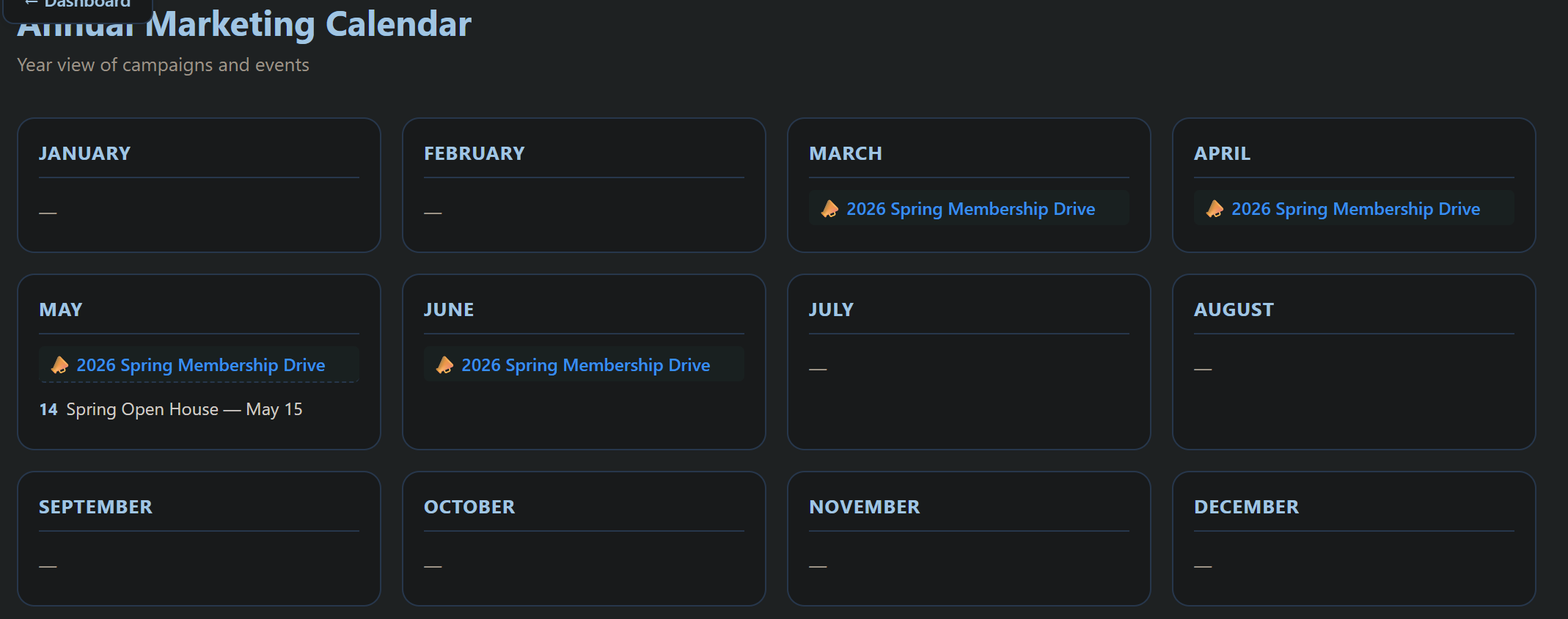
Key features
- Marketing plan builder tied to your goals.
- Content calendar to schedule and stay consistent.
- Channel strategy across email, social, and web.
- Campaign templates you can export and reuse.
- Email Campaign: compose and send a real broadcast email to your prospects, contacts, or donors through your connected email tool (MailerLite, Mailchimp, or Brevo) (see the write-up below).
How to use it
- Build your marketing plan and goals.
- Lay out your content calendar.
- Produce campaigns from the templates and track them.
Email Campaign
The Email Campaign page is a one-off email broadcast composer, the same engine as the Membership Newsletter, aimed at your marketing audiences (prospects, contacts, or donors). It sends through your connected email tool (MailerLite, Mailchimp, or Brevo), so your email tool owns the sending, the list, unsubscribe handling, deliverability, and CAN-SPAM compliance. Connect your email tool once on the My Organization page, then it is ready here too.
- Compose multi-section emails: subject, preview text, an optional header banner image (uploaded and auto-shrunk to about 1200px wide), and repeatable sections with a heading, body, and an optional per-section image you can upload and remove, with a live Preview.
- Bring your own HTML: paste your HTML or upload an .html file to send as is.
- Draft with AI (included): turn a few topics into a drafted subject and sections.
- Saved templates, Clear and start over, and Download or Copy HTML for reuse or hand-pasting into your email tool.
- Choose your audience: pick a list under "Send to," or "Build a group from your records" to sync your Contacts or Donors into a list in your email tool in one click.
- Create a draft, Send now, or Schedule through your connected email tool (drafts and scheduling are available with MailerLite; Mailchimp and Brevo support instant send). Drafts and sent campaigns live in your email tool's campaigns area.
A note on MailerLite plans: With MailerLite, API send of content All In One Nonprofit built for you requires the MailerLite Advanced plan. On the Free or Growing Business plans, use Download HTML or Copy HTML and paste it into MailerLite to send. Verified 501(c)(3) organizations get 30% off MailerLite paid plans. Mailchimp and Brevo each have their own API key settings and plan requirements.
For a step-by-step first session, see the Marketing guide.
Open Marketing →Grant Management
Find funding, manage your grants pipeline, and write stronger proposals: search foundations by what they actually gave and Grants.gov from inside the app, keep every deadline and report date on one calendar, and build proposals and letters of inquiry section by section.
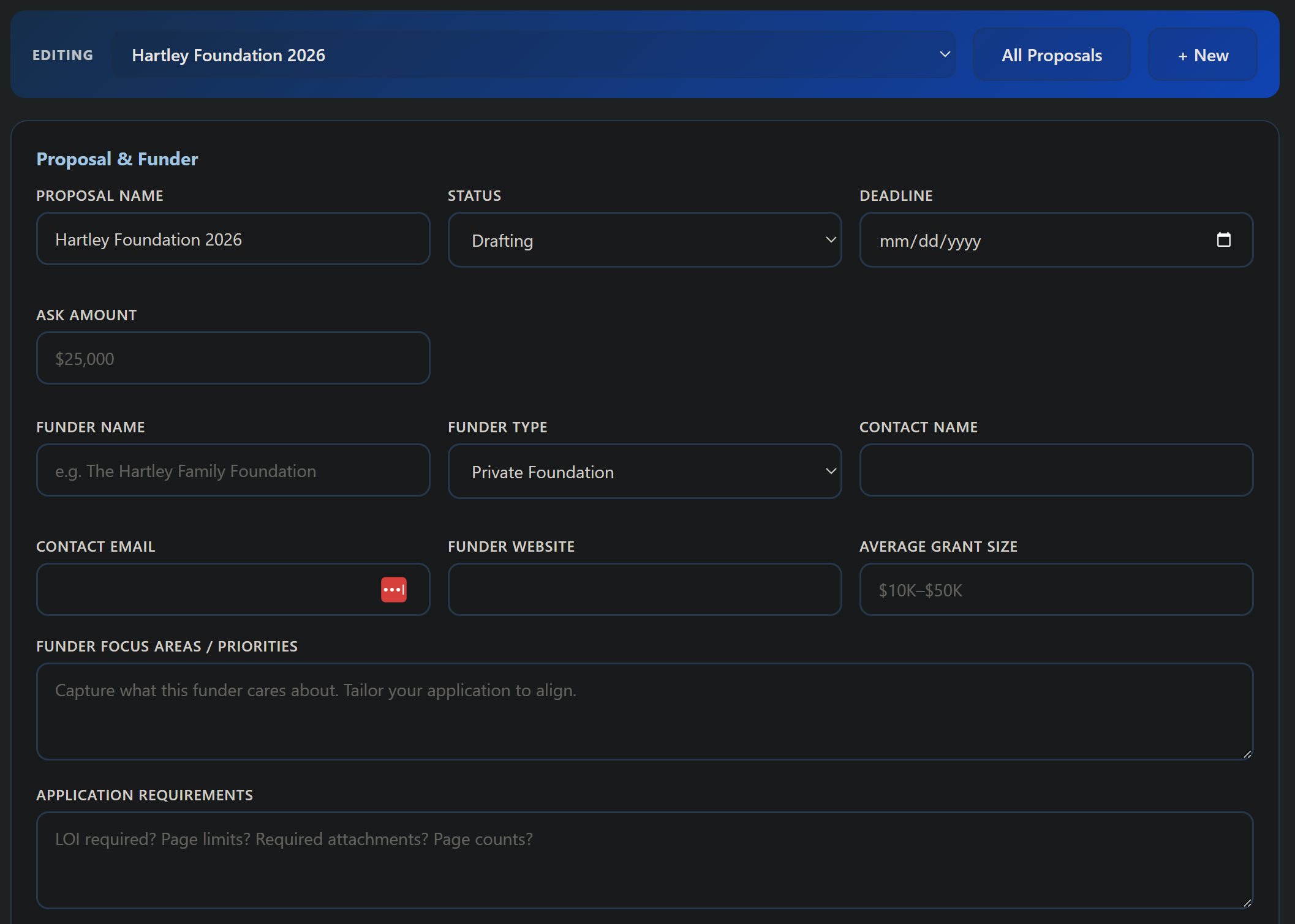
Key features
- Grant Sources directory: a curated, searchable list of where to look for funding (federal, state, foundation, corporate, plus free and paid search platforms), with guidance on how to qualify opportunities for fit.
- Find Grants: search the platform's own 990-PF funder index, Grants.gov, any IRS filer by name or EIN, and a Who funds work like mine tab that searches recipient-level Part XV grants by keyword and city, each scored for fit.
- Grants pipeline with prospects, stages, and deadlines.
- Payments recorded as they arrive, and booked: record each payment on the grant as it lands and it writes an entry in Financial Management dated the day the money came in. Marking a grant Awarded books nothing on its own, deliberately, because an award is a promise and the books are kept on a cash basis. One grant can pay in installments, each recorded separately against a running total, and removing a payment reverses the entry rather than deleting it.
- Post-award management: an Awarded Grants page that tracks each grant's period, spending, conditions, and full report schedule, with overdue and due-soon alerts plus automatic email reminders before each report is due, so you never miss a funder report.
- Proposal and letter-of-inquiry builders with guided sections.
- Narrative help to turn your work into fundable language.
- Word export on your letterhead.
- Predictions (free): a grants pipeline forecast, a funder-fit indicator, and deadline risk. See Predictions.
- Grant Readiness Assessment: find out whether you are ready to apply before you write another proposal. A twelve-item eligibility screen runs first, because a handful of prerequisites stop an application outright no matter how good the writing is, then a deep dive filtered to your budget size and the kinds of grants you pursue. You get a weighted score, a breakdown across eight areas from legal standing to post-award reporting, and a prioritized list of what to fix first, each with a specific fix rather than a restatement of the problem. Enter your EIN and it checks public IRS records to confirm your legal name, your 501(c)(3) subsection and ruling date, whether your tax exemption is still current, and your Form 990 filing history, so those answers are verified rather than self-reported. Results save to your organization's record so a later assessment can show a gap actually closed. If you would like it run as an interview with evidence requested and sighted, ask us and a staff member can facilitate it with you.
How to use it
- Add prospects to your pipeline with their deadlines.
- Build the LOI or proposal section by section.
- Export to Word, finalize, and submit.
For a step-by-step first session, see the Grant Management guide.
Open Grant Management →Annual Report
Build a polished annual report that tells your year's story: impact stats, financials, and donor recognition, exported to Word or PDF on your letterhead.
Key features
- Guided report sections: letter, impact, programs, financials, and thanks.
- Impact stats and financial summary blocks.
- Donor recognition lists.
- Word and PDF export on your letterhead.
- Reports (monthly, quarterly, annual): a board report built only from your records (filings due, filed and overdue, income and giving against the prior period, board attendance and ending terms, open HR items, expired screenings), on any organization your account belongs to, plus budget against actual, donor retention and the grants pipeline, a Prepared by (person) line with your name, an AI narrative you approve section by section, and a Word export carrying the author letterhead and the subject organization.
How to use it
- Fill in each section, add your numbers and donor list, export to Word or PDF.
- For a board report, open Reports, pick the cadence, period and organization, build, approve the narrative, export.
For a step-by-step first session, see the Annual Report guide.
Open the Annual Report builder →Scholarship Management
Run a clear, fair, and compliant scholarship program: generate the policy, application, rubric, committee charter, and award and decline letters, track applicants and their scores, record awards, and let AI draft the writing, all on your letterhead.

Key features
- Document templates: program policy, application, scoring rubric, committee charter, award and decline letters, and disbursement policy.
- Applicant pipeline and scoring: track applications, score them against your rubric, and flag conflicts of interest.
- Award ledger: record awards and disbursements with proof and status.
- A short course and AI automations to design and run a program built on objective, nondiscriminatory criteria.
- Predictions (free): rubric-based applicant ranking and a shortlist as a decision aid for your committee, objective and nondiscriminatory and never an automated award, with the factors behind each score. See Predictions.
How to use it
- Design your program and generate the documents.
- Track applications and score them against your rubric.
- Record awards, then send the award and decline letters.
For a step-by-step first session, see the Scholarship Management guide.
Open Scholarship Management →Free Resources
Get real value before you buy anything.
The Nonprofit Starter Kit is a free, nine-part diagnostic library that helps brand-new founders figure out what they actually need: What is a 501(c)(3)? · Form your own or use a sponsor? · Name & mission · Your founding board · What it really costs · Which IRS form? · The formation timeline · Can you accept donations yet? · Common pitfalls. Each kit is a short, three-minute self-check that points you to your next step.
The Learn blog goes deeper with articles on the biggest board mistake, your first 30 days after IRS determination, SEO for nonprofits, state incorporation essentials, and more.
Site-Wide Features
Capabilities that work across the whole platform, not just one app.
- Every app tells you what to do first: open one you have not used and a short Start here panel offers the four to six moves that actually matter in that app, in the order somebody should do them, each with a button that opens the exact page. It appears only while the app is genuinely empty and does not come back once you have started.
- Long screens fold away: every content box that leads with a heading now carries an arrow on that heading, so you can close the parts you are not using and keep what you are working on in front of you. Boxes start closed, so a screen opens short instead of long, and each one remembers what you left open on that device.
- Money you collect reaches your books on its own: when a payment goes through your connected Stripe, the platform writes the accounting entry at the same moment, so nobody keys the same money in twice and your books are never short by whatever the platform took in. Six paths do this: online donations, recurring gifts, event tickets, sponsorship and auction payments, form payments, and membership dues including new memberships.
- Donors can choose which fund they are giving to: you name the funds a donor may pick from, each with a short line explaining it in the donor's language and a tick for whether gifts to it are genuinely restricted. The list starts empty and while it is empty your giving page asks nothing at all, because most organizations have no restricted funds and nobody should be shown a question they cannot answer.
- Everyone gets a first-week checklist, not just the account owner: a treasurer, secretary, committee chair or director signing in for the first time now sees a checklist written for the position they hold, rather than the blank screen non-owners used to get. Officers get the fuller lists because their roles carry real duties, and somebody holding no position gets the basics plus one line explaining that positions decide who is told when money arrives and that only the owner sets them.
- Run more than one organization from one sign-in: an account can belong to several organizations (a membership society plus its foundation, or a fiscal sponsor with several projects). A dropdown on your apps portal switches between them and every app follows the organization you pick; each keeps its own separate data. Accounts switched on for the Workspace (app.allinonenonprofit.com/workspace) also get one screen with a block per organization, closed by default so a long list stays short: the next filing and overdue filings, revenue, giving, expenses with net and restricted money, the organization health score with its top item, which of the four key records are on file (bylaws, IRS determination letter, most recent Form 990, conflict of interest policy), open HR items and expired volunteer screenings, and grants open, awarded and reports due. Click a name to expand it; the organization shaded green is the one you are working in; Open My apps switches to an organization and Create report builds a report on it without switching. Click a row to switch, or use the row's Reports link to prepare a report on that organization without switching. Ask support to turn it on; it is on automatically for any account that one or more organizations have marked as their Consultant.
- Your whole team works on the same records: app data belongs to the organization, not the person who typed it in. Everyone you invite works on the same member roster, board roster, and registers.
- Member Directory in the member portal: members can opt in to a directory and choose exactly what to share (name only, or email and phone too), so people in your organization can find each other. Everyone starts hidden; sharing is always the member's choice.
- Improve an existing document with AI: besides drafting from scratch, every app's AI Automations page lets you upload a document you already have (a letter, appeal, policy, plan, or governance document) and AI reviews it and returns a cleaner version plus a prioritized summary of what changed, with your original always kept. It opens the Document Library's Improve with AI tool preset to the right document type.
- One place to search everything: Help searches every guide, playbook and setup article at once. Ask in plain words rather than guessing which page to open, and it returns the section that answers you instead of a list of documents to read.
- Get to your apps fast: the four-square logo at the top left of every app takes you straight back to your apps launchpad, and the My Apps control in every app is now a menu: open it and jump directly to any other app, or to All apps and settings, without going through the launchpad first.
- The platform points you at the right apps first: the first step when you set up your organization is six short questions: what kind of organization you are, where you are today, what you would most like to fix first, how many people are on your board, how many paid staff you have, and whether you collect money online. Your answers put a Recommended for you group at the top of your My Apps page, with the whole catalog one click away behind a Show all apps link, so a brand new organization gets a short starting list instead of every app on day one.
- An empty app tells you what to do first: when you open an app for the first time and there is nothing in it yet, you no longer get a bare line saying nothing is there. You get four suggested first moves, each with a button that opens the exact control that does it.
- The numbers on your dashboard are links: every count on an app's dashboard opens the page that number came from. In Donor Management, clicking Donors opens the donor directory and clicking Unacknowledged opens the gifts still waiting on a thank-you; in the Compliance Tracker, clicking Overdue opens your filings.
- Every app explains its own words, in place: the fields that use language a volunteer would not be expected to know now carry a small blue question mark beside the label. Click it and a short plain explanation opens under the field, saying not just what the field is but why it matters and what goes wrong if you guess.
- Additional emails and shared contact records: in Membership, Donor Management, and Volunteer Management you can store several email addresses for one person in an Additional emails field, saved and searchable. When the same person is in more than one of those apps, you can link their records into one shared contact record, so you maintain the person's name, emails, and phone once instead of in three places, and editing a linked record updates it everywhere.
- Links open where you are, not in a new tab: moving around the platform now replaces the page you are on instead of piling up browser tabs. Only links that genuinely leave us (a state filing office, the IRS, Candid) open a new tab, and those are marked with a small arrow so you know before you click.
- You always know where you are: every guide, AI guide and walkthrough carries a trail across the top reading My Apps, then the app, then the page you are reading, and each step is a link back.
- Record who does what, so notices reach the right person: My Organization now has a Who does what section where you record who holds each position: President, Vice President, Executive Director, Treasurer, Secretary, Director, and the chairs for Fundraising and Development, Membership, Volunteer, Communications, Finance, Technology, Grant Management, Marketing and Scholarship. This is a different question from Member access above it.
- A flagged background screening is escalated on its own: in Volunteer Management, the moment you set a volunteer's screening to flagged, the platform emails whoever holds the Executive Director position. It names the volunteer and says a screening needs your review, and it deliberately does not repeat the finding, because a background-check result about a named person should not travel by email where it gets forwarded and outlives your access controls.
- Where this connects: apps that create or consume money now carry a short Where this connects strip that links to Financial Management on the page the number lives on. Gifts recorded in Donor Management become income in your books, dues collected in Membership do the same, and the Annual Report's financials section is built from those figures.
- Team, board, staff and committee explained: My Organization has a short explainer for the four groups people are sorted into, because the difference matters and is easy to guess wrong. Team is everyone who can sign in and open apps; Board is the directors on your board roster; Staff is the employees in your HR directory; Committee is the people on one specific committee.
- Tours wait until you want them: an app no longer offers you its tour the moment you open it. Every app keeps a Take the tour button, so you start it when you are ready rather than being interrupted while you set something else up.
- Always know which platform you are in: your apps portal shows a clear platform label at the top (Nonprofit platform on All In One Nonprofit, Club platform on Build Your Club), and every app screen carries a small matching badge, so if you work across both brands, or run a club and a nonprofit, you can tell at a glance which platform you are signed into.
- Emails carry your organization's name: the emails the platform sends to your people on your behalf (membership renewal reminders, invitations, event and payment confirmations, portal sign-in links) arrive with your organization's own name as the sender, and platform notices to you carry the platform's name, so nothing your members receive reads like it came from a stranger.
- Document branding: set your letterhead, footer (address, phone, email, website, EIN, optional page numbers), and personal signature once; they apply automatically to the Word and PDF documents your tools generate. Letters and emails get your signature at the closing; formal documents get the letterhead and footer.
- Calendar invites carry the time zone: when you send a meeting invite from Board Management or an appointment from Contact Manager, the invitation records the actual moment, not just the numbers on your clock. A board member in Houston opening an invite you set for noon Eastern sees 11:00 AM Central on their own calendar, which is the same instant.
- One passwordless sign-in: across every app and the main site: enter your email for a one-click sign-in link (or use Google), no separate password per tool.
- Step-up verification on sensitive actions: before you permanently delete your account, dissolve your organization, manage billing, or add or remove an organization Admin, we email you a one-time code to confirm it is really you, an extra check that only appears for those high-stakes actions. Because sign-in stays passwordless (Google or a one-time email link), a short security note also encourages you to turn on two-factor authentication with your Google or email account, so the account you sign in with is protected too.
- Organizations: a shared organization profile your board and staff all work from. Sign in with an email on your organization's domain and you join automatically; teammates on a personal email join with an invite code.
- My Organization is your single hub (at allinonenonprofit.com/team): the My Organization page is now the one place for everything about your organization: your identity and profile (name, EIN, address, mission, default signer), your branding (letterhead, footer, and signature), your organization language (see below), and your organization-wide connections (online donations through Stripe and email through your connected email tool: MailerLite, Mailchimp, or Brevo). Set it once and it carries across the whole platform. Open it.
- Organization language customization: rename the platform's terms to match your own world, chosen once on the My Organization page and delivered to the apps automatically. For example, a church or faith-based organization can show "tithe" or "offering" instead of "donation" and "giver" instead of "donor", and a sports league can show "player" instead of "member" and "registration fee" instead of "dues". Open it.
- Role-based permissions: control what each member of your organization can reach. On the Team page (My Organization), an owner sets each member's access: a preset role (Treasurer, Secretary, Programs, Fundraising, or Operations) that opens the tools that role needs, an Admin level (full access to every tool plus permission to edit the organization profile and settings; managing members and billing stays with the owner), a Custom option to pick specific tools, a read-only Viewer (can open and view everything but cannot make changes), a Consultant (for an outside consultant who serves your organization: read-only like a Viewer, can prepare reports about you from their own account, and their Workspace lists your organization automatically), or Full access. A restricted member only sees the tools they are allowed and cannot reach the others. The default is full access, so nothing changes until an owner restricts someone, and owners and admins always keep full access.
- Activity log and sign-in history (owner oversight, on the Team page): as the owner you can see what is happening in your organization. A Member sign-in activity card shows when your team and board members last signed in, and an Activity log records the important changes, who changed a member's access, sent an invitation, removed a member, connected payments or email, and shared, deleted, or disposed of a document, each with the date, the person, and what changed. Open it.
- Clean up duplicates and import from CSV: Donor Management, Membership, Volunteer Management, and the Technology Organization Contacts list each include a Find duplicates tool that detects records sharing an email or name and merges them (the donor, member, and volunteer merges carry all linked history and offer an undo), plus a guided CSV import wizard that maps your spreadsheet columns, previews new versus existing records, and imports with de-duplication by email. Donor Management can also import a gift-history CSV.
- My Account (at allinonenonprofit.com/account): one signed-in page for your own account. It shows your plan and the apps you can reach, and a Billing & renewal card with the amount, next renewal date and a Manage billing button (secure Stripe portal, or a PayPal link) to update payment details or cancel; after a cancellation you are not billed again and access runs to the end of the paid period. Download everything in one click: a zip of your records as CSV plus the files in your Document Library, just the spreadsheets, or a full JSON backup, with per-list CSV exports for donors, gifts, members and contacts. Owners and Admins also keep the Organization profile here (name, EIN, address, mission, default signer, letterhead, signature, footer lines) and every app pre-fills its own settings from it, filling blanks only. Delete your account is a 14-day soft delete that signing back in cancels; an owner must dissolve or transfer an organization that still has members or data first. This page is your data-access and right-to-erasure control, and it is linked from every app sidebar, My apps and My Organization.
- Committees & contacts on your Team page: (app.allinonenonprofit.com/team): keep committee rosters shared across the apps. Each committee has an Import members (CSV) button so you can add a roster from a file in one step (columns Name, Email, Role; Email is required). Open it.
- Glossaries: plain-language definitions of the jargon inside the compliance and formation tools.
- Search: find what you need fast, like the 126-item Committees template library or the AI Workflow templates.
- In-app user guides: every app has its own built-in guide.
- Collapsible lists with filter and sort: across the record-keeping tools, any list that grows over time (board rosters, donors, gifts, pledges, events, volunteers, committees, grant proposals, scholarship applications, and more) shows each record as a collapsible card with a one-line summary, so a long list stays scannable; click a card to open its full editor. Each list also has a controls bar to filter by status or category, sort the list, and expand or collapse everything at once.
- Document Library (live at docs.allinonenonprofit.com): a per-organization vault for any file (bylaws, 990s, minutes, scans, spreadsheets), with version history, search across every collection, filters by app, type and tag, grouping, archive and restore, and a storage allowance that grows with your plan (up to 50 GB). A Document Library link sits in every app sidebar, and Save to Library in an app's export menu files a draft straight into the vault; signed e-signature PDFs, training certificates and board strategic-progress reports file themselves. Three collections keep it tidy: Working Documents, Organization Records (anything with a retention category lands here automatically) and Templates, which includes a starter gallery of ready-made blanks (thank-you letter, board agenda, resolution, conflict-of-interest disclosure, gift acknowledgment, volunteer waiver, policy acknowledgment, MOU, donation receipt, press release). Share with members puts a file in the member portal. Document approval routes any file to one or more approvers (a private email link for anyone without an account) and records who approved which version. Create a document starts from a template, an upload or an AI improvement of your own file. Board Packet merges the PDFs you pick into one packet with a cover and contents page, files it, and can share it with members.
- Upload and improve a document with AI (in the Document Library): bring your own document and let AI make it better. Upload an existing file (a Word .docx, a text-based PDF, or a text file), or click Improve on a document already in the library. Open it.
- Member portal (board and volunteer self-service, live at allinonenonprofit.com/member): a separate self-service space for the people on your board and volunteer roster. A member signs in with a passwordless magic link, no account to set up, and sees for each organization they belong to: documents To Sign, My Assignments (committees and roles), Events to register for, Documents you chose to share, Training assigned to them, a read-only Strategic progress view, and any committee update their chair has requested. Volunteers log their own hours and sign up for shifts; logged hours arrive in Volunteer Management as pending until staff approve them. Each member keeps their own profile, contact preferences and sign-in security on the same page without changing your records. An Ask a question box and a Need help hub give members one place to go, the portal installs on a phone with optional push notifications, and Back to your apps opens the My apps launchpad.
- Forms and surveys (live at allinonenonprofit.com/forms, signed in): build a form or survey, collect payments, and feed signups straight into the right app. Add questions from a full set of field types (short text, long text, email, phone, dropdown, multiple choice, checkboxes, date, file upload, and a consent checkbox), reorder them, mark them required, and add conditional logic so a question only shows when an earlier answer matches. Open it.
- Training modules (live at allinonenonprofit.com/training): build and assign training for your board and volunteers, who take it from the member portal. A module is a video (embed a YouTube or Vimeo link, or upload a file) plus a completion check that is either a one-click acknowledgment or a multiple-choice quiz with a passing score (an AI button can draft the quiz questions for you from the module title). Open it.
- Strategic Progress tracker (live at allinonenonprofit.com/strategy): turn your strategic plan into something the board can actually monitor. It joins the strategic plan you write in the Executive Director app with the metrics you track in the Impact and Outcomes app: list your priorities and goals, then attach the impact indicators that measure each one so the live status (on track, at risk, behind) is pulled straight from your numbers, suggested automatically and yours to override. Open it.
- AI assistant that answers from your own organization data (live at allinonenonprofit.com/assistant, signed in): ask a plain-language question about your organization and get an answer drawn from your live data, with deep links that open in a new tab. The flagship question is "When is our next filing due?", and it also covers filings and compliance deadlines, governance (board terms expiring, conflict-of-interest status, training outstanding, off-track strategic goals), which key governance documents are on file (with links straight to them in the Document Library), outstanding signatures, upcoming events, and strategic progress. Open it.
- Ask All In One Nonprofit (guide-grounded support agent): the "Ask All In One Nonprofit" box now answers your detailed how-to questions directly, drawing its answers from the Complete Guide and every per-app guide and giving you citation links to the sources it used, instead of only pointing you to which app to open. When it does not have a good answer it still routes you to the right app. Open it.
- Scenario Playbook (step-by-step answers by task): a built-in playbook answers the common how-do-I questions for every app, each with the situation, the exact steps to take in the platform, and what to prepare. Browse it from a Playbooks link in every app's sidebar (right after Document Library) or at allinonenonprofit.com/playbooks. Open it.
- Notification center (Needs your attention, live at allinonenonprofit.com/notifications): one signed-in feed that gathers the things actually waiting on you across all your apps: documents awaiting your approval, items waiting for you to sign, open board votes you have not cast, overdue obligations from your calendar, Compliance Copilot risk flags, and new replies on your support requests. Each item links straight to where you handle it. Open it.
- Install as an app, with push notifications: Donor Management, Volunteer Management, the member portal, and the My apps portal itself (app.allinonenonprofit.com) can each be added to your phone or computer's home screen so they open full screen like a regular app and keep working offline for data you have already loaded. On iPhone and iPad this must be done from Safari (Share, then Add to Home Screen), and installing is required before notifications can be turned on, Apple's own requirement for any website-based app. Open it.
- Notification permissions (who receives what): on the Organization Settings page, a Notification Permissions card lets the owner and admins control notifications per person and per category. The owner and admins always receive donation, ticket-sale, time-off, and digest notifications; any other member receives a category only when it is granted to them. Open it.
- Organization Health Copilot (live at allinonenonprofit.com/copilot): one signed-in dashboard that gives your organization a single Health Score from 0 to 100, blended across four domains (Compliance, Governance, Documents, and Operations, weighted with compliance and governance heaviest). It lists the specific issues that need attention most urgently first, each with a button that opens the app that fixes it, and it builds itself automatically from the data you already keep in your Compliance Tracker, Board Management, Operations Audit, and Document Library apps (a domain with no data yet shows "not enough data" rather than a zero). Open it.
- Monthly usage and savings report: subscribing organizations receive a monthly email (to the owner and org Admins) showing how many AI automations they ran, the estimated hours and dollars saved (the same per-automation estimates as the live savings dashboard), their most-used automations, a personalized tip, and one fact drawn from their own records. A fuller quarterly deep-dive replaces the monthly report in January, April, July, and October.
- Your deadlines in your own calendar: the shared Calendar page gathers your organization's dated items (events, board votes and meetings, signature and document deadlines, and now your compliance filing deadlines, plus a reminder to finish your organization profile) into one place. Copy the private subscribe link and add it in Google Calendar, Apple Calendar, or Outlook (Add calendar, then From URL) to see these deadlines alongside your own, and optionally turn on a weekly email summary of what is overdue and due this week. Open it.
- Electronic signatures (collect signatures, not just stamp your own): the platform can now gather real signatures from people, not only apply your organization's own signature to a document. When you send a document for signature you can upload a PDF or type the text yourself (Word upload is not supported yet). Open it.
- Committee chat: each committee on your Team page has a built-in real-time chat with a live presence panel and full message history, so members can talk in the same place they manage the roster, no separate tool needed. Committee chat admits only that committee's members (manage the roster in the Committees app or on the Team page); the owner and admins always retain access. Open it.
- Team chat in every app: a "Team chat" button sits in the corner of each app and opens a real-time, organization-wide chat (with live presence, typing indicators, and full message history), so you and your team can talk from wherever you are working, not only on the Team page. Team chat is open to everyone in your organization with app access.
- Staff chat (employees only): a real-time chat for your staff, available in the HR Management app and the member portal, limited to the employees on your HR directory (contractors are excluded unless you specifically include them); the owner and admins always retain access. Board members and volunteers never see it.
- Built-in customer support (at allinonenonprofit.com/support): get help without leaving the platform. A Contact support link sits in every app's sidebar and on your My apps portal, and it opens the support page already tagged with the app you came from. Open it.
- Board decisions and async voting: a board can decide between meetings. From Board Management (or the member portal) open a motion as a consent action or an advisory poll; board members vote for, against, or abstain from a one-click link emailed to them, from the member portal, or in the app.
- Board channel (private board-only chat): a real-time chat room limited to people on your board roster, in Board Management and the member portal, with live presence and full attributed history. Sensitive board conversation stays off personal email and group texts, and you can lift a single message or the whole transcript straight into a retained Document Library record, so the discussion that led to a decision is captured with the decision.
- Interactive guided tours and walkthroughs: nearly every app includes an interactive guided tour that highlights each part of the screen step by step, with a first-run "Take the tour" prompt, a launcher to reopen it anytime, and saved progress so you can resume where you left off. Every app also has a written walkthrough page, and there are standalone walkthroughs for the cross-app surfaces (Document Library, member portal, training, Strategic Progress, the Health Copilot, the AI assistant, and support), so a new user gets oriented without reading a manual.
- In-app courses, now full lessons: the skill apps include a Course Modules course (about six modules, each ending in a quiz), and every reading lesson is a complete walk-through: a clear point, why it matters, a worked example using a running real-feeling nonprofit, and a do-this-next step, so the courses teach actual nonprofit practice rather than just clicking buttons.
- Accessible public pages: the pages your supporters and the public actually use, your donation page, event registration, public forms and membership signup, and the e-signature and board-vote links, are built to common web accessibility practices: every field has a proper label, choices are grouped for screen readers, the keyboard works throughout (including the signature method controls), required fields and status or error messages are announced, focus is clearly visible, and text contrast is kept readable. This helps everyone, including supporters who use a screen reader or keyboard, take part, and it reflects the accessibility expectations many grantmakers now ask about.
- Helpful Resources (at allinonenonprofit.com/helpful-resources): a curated list of vetted external resources for things that live outside the platform, government and legal/tax filing sites, funder research databases, governance and board training, insurance guidance, nonprofit technology discount programs, fundraising education and certification, and sector news and policy. Every app's guide links here from its Contact & Support section. Open it.
- Earn a Candid Seal of Transparency (at allinonenonprofit.com/candid-seal): a step-by-step guide to claiming your Candid profile (formerly GuideStar) and working up the Seal of Transparency from Bronze to Platinum. We encourage every organization to earn one, and much of what the Gold and Platinum seals ask for (financials, leadership data, and impact metrics) is exactly what your Financial Management, Board Management, Annual Report, and Impact and Outcomes apps already help you assemble. Open it.
- Read your dashboard over a period, not only since the beginning: Donor Management, Membership, Volunteer Management, Impact & Outcomes and Marketing each carry a range picker above their dashboard tiles, with all time, this week, this month, this quarter and this year. It changes only the tiles that measure activity over a period: money raised, dues marked paid, volunteer hours logged, data entries recorded, campaigns launched and posts published.
- Every app fits a phone: each one lays out inside a 375 pixel screen with no sideways scrolling, and the controls you reach for most, the My Apps button, the Need help pill and the dashboard range picker, are sized for a fingertip rather than a mouse pointer.
- Skip straight to the content with a keyboard: press Tab on any app and the first thing you land on is a Skip to main content link, so a keyboard or screen reader user does not have to walk the whole sidebar to reach the page. Every app also marks its main content region properly, which is what lets a screen reader jump there directly.
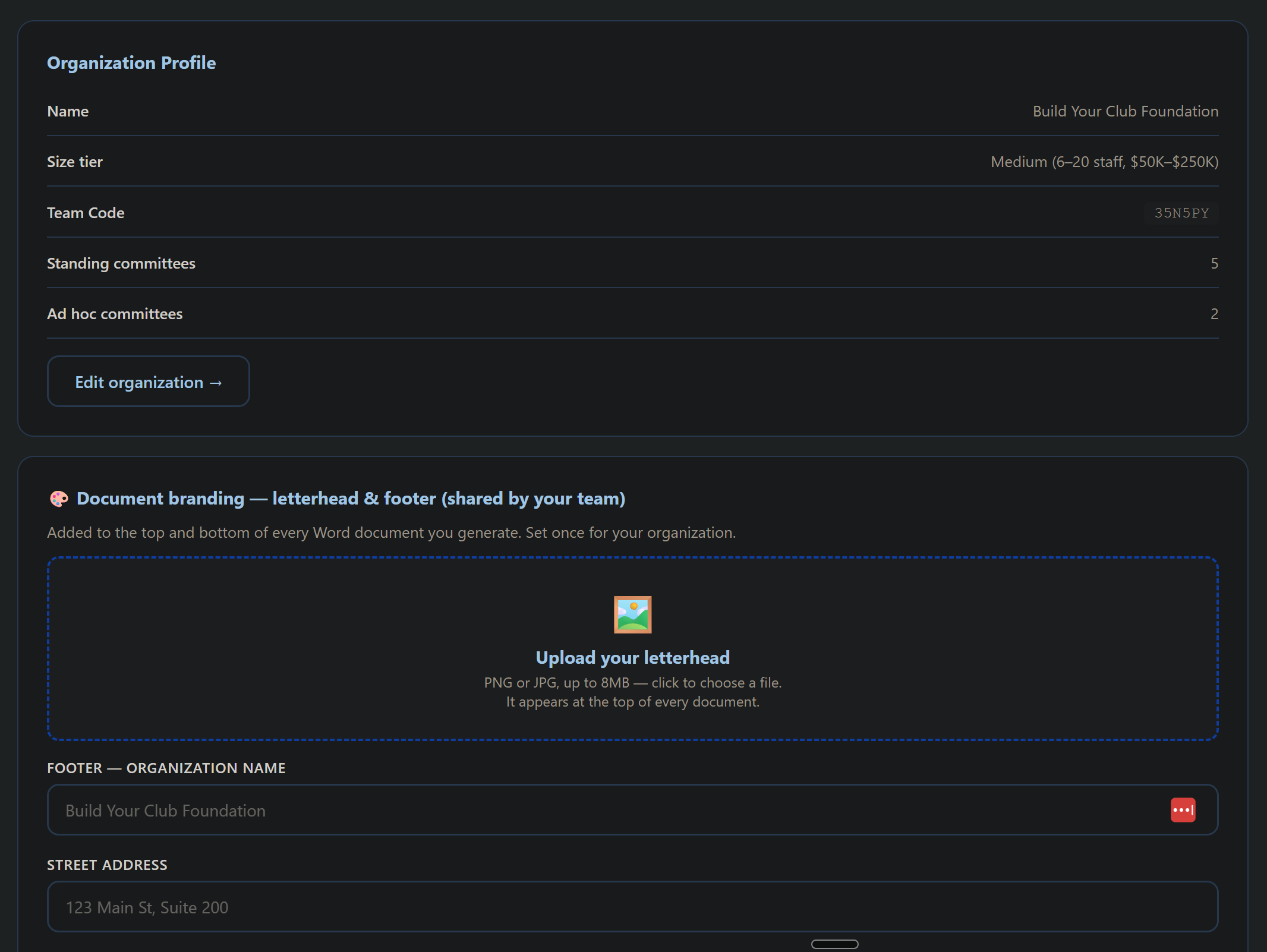
Pricing & How to Buy
One simple plan. An All-Access Subscription unlocks every app, all 200+ AI automations, and every free resource guide, plus a free Nonprofit Starter Kit and Learn blog to explore before you subscribe.
- Free, the Nonprofit Starter Kit and the Learn blog, real value before you buy anything.
- Free resource guides: downloadable PDF toolkits in the Resources section, included free with your subscription, covering bylaws, board setup, compliance, volunteer management, and more.
- All-Access Subscription: one plan covers every app, all AI automations, and all free resource guides. See pricing for the Founding Member rate.
- AI automations included: every subscription includes the AI that drafts, analyzes, and compiles from the data already in your apps, with no separate add-on. Founding Member rate from $99/mo.
Subscribe at the pricing page. Checkout is handled securely by card (Stripe) or PayPal, and your access is tied to your sign-in so every tool is available on every device immediately after subscribing.
Have a discount or promo code? Use the Buy with Stripe button: a code box appears on the Stripe checkout page where you enter it. Codes work on the subscription. PayPal cannot accept discount codes, so choose the Stripe (card) option whenever you have a code.
Support & Contact
Questions, feedback, or help getting set up?
Email [email protected] and we'll get back to you.